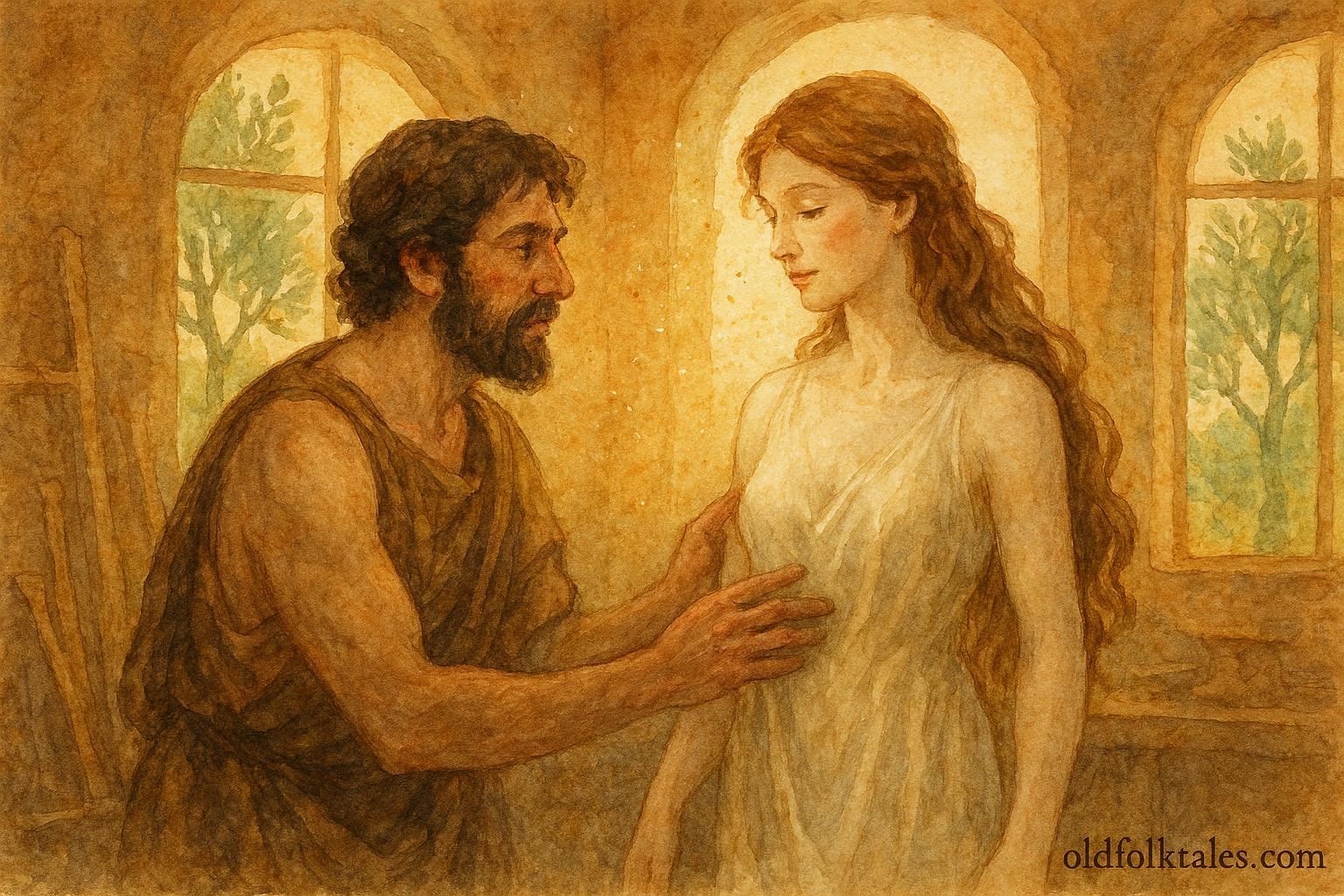
On the sun-drenched island of Cyprus, where the white marble of temples gleamed under the Mediterranean sky and the marketplace hummed with the voices of traders, musicians, and children playing in the streets, there lived a sculptor named Pygmalion. He was renowned throughout the city for his unparalleled skill, able to breathe life into marble with the careful precision of his chisel and the vision in his mind. People often said his statues were so perfect that they seemed almost alive, as if they could blink or turn to speak at any moment.
Yet, despite his fame and talent, Pygmalion felt an emptiness in his heart. Observing the women around him, he grew disillusioned. They seemed frivolous and vain, concerned more with appearances and social gossip than with virtue or substance. This perception gnawed at him, leaving him cold and withdrawn. While others sought love, companionship, or marriage, Pygmalion sought something entirely different: perfection, not only in form but in character. He longed for a woman who embodied both beauty and moral virtue, a being free from the flaws he despised.
The Sculptor’s Devotion
In the quiet seclusion of his workshop, filled with the scent of marble dust and pine resin from his tools, Pygmalion began his most ambitious work. He selected a flawless block of ivory, its smooth surface gleaming under the rays of the morning sun. For days and nights, he toiled without pause, carving with a meticulous hand, shaping every curve and line with painstaking care.
As he worked, he imbued the figure with his ideal of womanhood. Her hair fell in gentle waves, cascading softly over her shoulders. Her eyes, carved with intricate precision, reflected a serene wisdom, a calmness that suggested understanding beyond words. Her lips curved with a faint, knowing smile, the kind that seems to promise both compassion and intelligence. Every delicate finger and swaying curve of her waist expressed elegance, poise, and subtle strength. To Pygmalion, she was not merely a statue but the embodiment of his deepest longing: a woman of perfection who transcended mortal flaws.
Pygmalion worked tirelessly, day blending into night. As the sun dipped below the horizon and the workshop filled with shadows, he would stand back, brushing dust from his hands, and gaze at his creation. A strange warmth would rise in his chest. He realized, with astonishment and unease, that he loved the statue. Not as an object, but as a being of spirit and intellect, as if her soul were present in the ivory, whispering to him through the stillness.
The Prayer to Aphrodite
Driven by longing and the need to transform this vision into reality, Pygmalion traveled to the temple of Aphrodite, the goddess of love and beauty. Her temples dotted the island, their marble pillars gleaming in the sunlight and adorned with carvings of swans, roses, and doves. Kneeling before the altar, Pygmalion clasped his hands over his heart and spoke with fervor:
“O divine Aphrodite,” he implored, “if there exists a form of love purer than any found among mortals, let it be mine. Look upon this creation, wrought by my hands and my devotion. Grant that she may walk the earth as I have envisioned her, that my love and artistry may bring life to perfection itself.”
His prayer was honest and unwavering. He offered no bribe, no sacrifice of wealth, only the depth of his desire and the sincerity of his heart. Though silent to mortal ears, the goddess heard him, moved by the devotion and purity of his intent.
The Transformation
Returning to his workshop, Pygmalion approached the statue once more. He ran his fingers lightly over Galatea’s cheek, tracing the elegant line of her jaw, feeling the smooth ivory beneath his touch. He whispered words of admiration, his voice trembling with hope and wonder.
Then, impossibly, the marble began to soften beneath his hand. A warmth spread through the ivory as though life itself were flowing into her. Slowly, delicately, the features he had carved so carefully took on the vitality of a living being. The eyes opened, revealing depth and consciousness. Her chest rose and fell in soft, gentle breaths.
Galatea turned toward Pygmalion, her gaze meeting his, filled with curiosity, wonder, and a tender recognition. She spoke, her voice as clear and melodious as a stream over smooth stones:
“Your devotion has called me forth, Pygmalion. You loved not for selfish desire, but for the perfection of being itself. Because of your art and your heart, I am alive.”
Pygmalion, overcome with awe and emotion, fell to his knees. Tears shone in his eyes, reflecting the golden rays of the afternoon sun. His prayers had been answered; the impossible had become reality.
Life with Galatea
In the days that followed, Pygmalion and Galatea became inseparable. She explored the world outside the workshop with the wide-eyed curiosity of someone experiencing life for the first time. Birds, flowers, and the rustling olive trees fascinated her, and she often laughed at the gentle play of sunlight on marble columns or the shimmer of the sea.
Pygmalion guided her patiently, teaching her about society, human emotion, and the nuances of daily life. In turn, she brought warmth, companionship, and joy to a heart that had long been lonely. Villagers whispered in awe as the sculptor walked through the marketplace with a living woman of unparalleled beauty, seeming almost touched by the gods themselves. The story of their devotion and divine blessing spread across Cyprus and beyond, inspiring songs, poems, and offerings at Aphrodite’s temples.
Reflections on Devotion
What made Pygmalion’s story remarkable was not just the miracle of creation, but the purity of his intent. He had not sought power, riches, or fame. His desire was born from admiration, artistry, and a vision of beauty that transcended ordinary human flaws. It was precisely this sincerity that won the favor of the goddess and transformed stone into flesh, in a story that would be told for generations.
Galatea, too, demonstrated that life created with love carries responsibility. She was no mere object of perfection; she was a partner, curious and learning, growing alongside Pygmalion. Together, they embodied harmony between human effort, artistic expression, and divine favor.
Moral Lesson
The story of Pygmalion and Galatea teaches that devotion, artistry, and sincerity can transcend the limits of mortality. True love is not possession, nor is it mere attraction—it is reverence, patience, and dedication to the ideal. Moreover, it reminds us that the divine often responds to purity of heart, rewarding those who act with honesty, care, and focus on what is virtuous.
Knowledge Check
1. Who was Pygmalion?
A Corinthian sculptor disillusioned with mortal women, renowned for creating the ivory statue Galatea.
2. What motivated him to sculpt Galatea?
He sought a woman who embodied perfection of form and virtue, free from flaws he perceived in real women.
3. Which goddess granted life to Galatea?
Aphrodite, goddess of love, beauty, and desire.
4. How did Galatea demonstrate her vitality after awakening?
She breathed, moved gracefully, and spoke with intelligence and curiosity.
5. What central themes appear in this story?
Devotion, artistry, divine intervention, idealized love, and transformation.
6. Where does the cultural origin of this story lie?
Ancient Greek folklore inspired by Cypriot mythological traditions.
Source: Adapted from Ovid, Metamorphoses, c. 8 CE
Cultural Origin: Ancient Greece (Cypriot-inspired myth)