In the lowlands of Brabant, where mist drifts across flat fields and rivers wind through quiet towns, there flows the great Scheldt River. Its waters have long carried ships, stories, and secrets. Among those secrets, none is more haunting than the tale of the Swan Knight.
It was a time when noble houses contended for power, and justice often rested not in law, but in strength of arms. In a riverside town not far from the Scheldt, there lived a young noblewoman named Elswitha. She was known for her grace and kindness, but also for her misfortune. Upon the death of her father, a powerful lord, a rival noble accused her of treachery and false inheritance.
The accusation spread swiftly, poisoning the minds of the court. Without proof, and with few allies to defend her, Elswitha faced the grim prospect of losing her lands, and her life. In those days, disputes of such gravity were often settled by trial of combat, and the accused might call upon a champion to fight in their defense.
Yet Elswitha had no champion.
On the eve of the appointed trial, she walked alone to the banks of the Scheldt. The sky was dim with gathering clouds, and the river moved silently, as if holding its breath. Kneeling at the water’s edge, she whispered a prayer, not to any one saint, but to whatever unseen force might hear her plea.
“Send me aid,” she murmured, her voice trembling. “For I have no one left to stand for me.”
The wind stilled. The surface of the river shimmered faintly, disturbed by no visible current. Then, from the distant mist, a shape began to emerge.
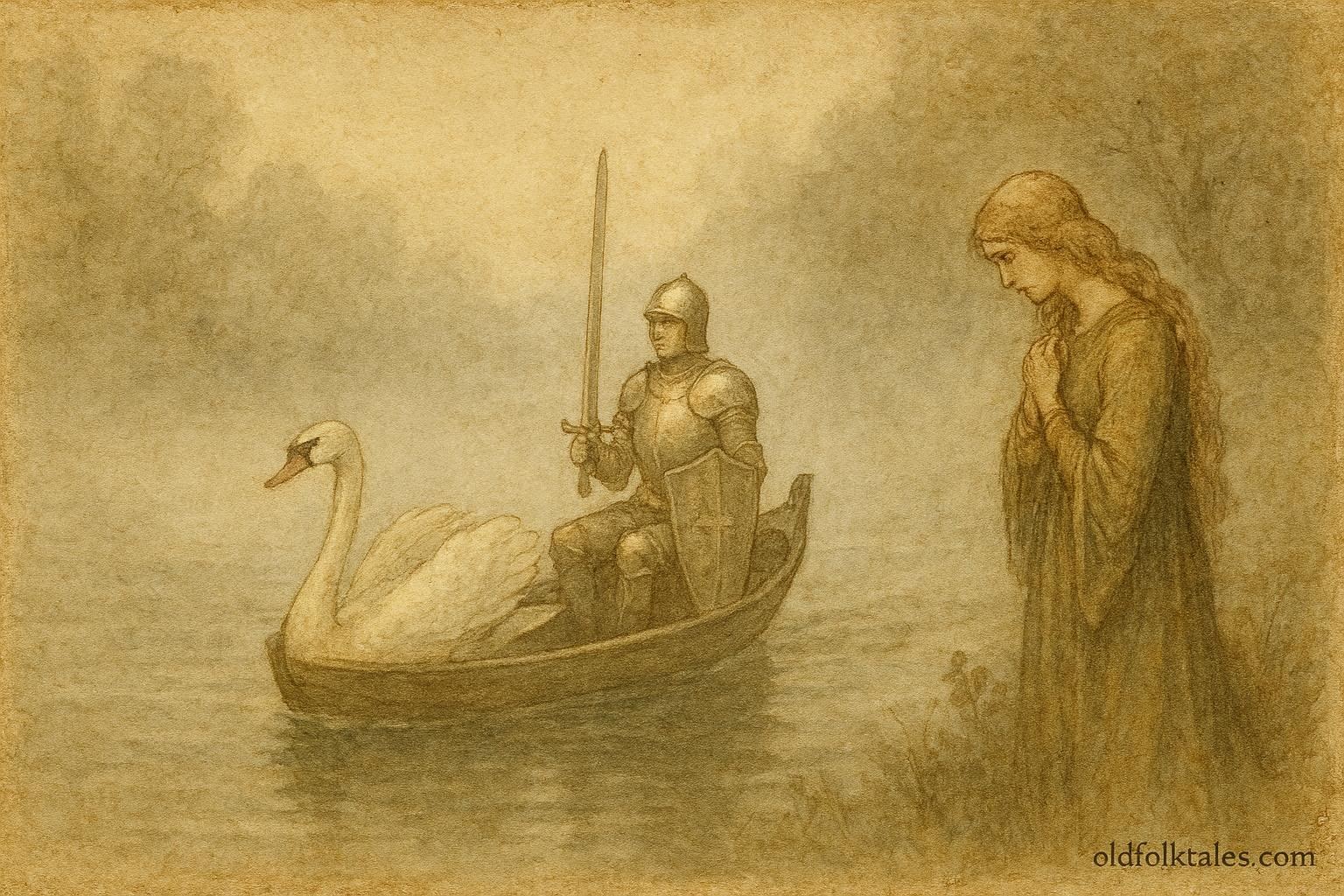
At first, it was only a pale glimmer upon the water. But as it drew nearer, the form became clear: a small boat, gliding effortlessly along the river, drawn by a single, magnificent swan. Its feathers shone with an almost otherworldly brightness, and its movements were silent, as though it were part of the river itself.
Standing within the boat was a knight.
He was clad in shining armor that caught what little light remained in the sky, and his bearing was both noble and serene. His face was calm, yet there was a depth in his eyes that suggested knowledge far beyond that of ordinary men.
The boat reached the shore, and the swan came to rest without a sound. The knight stepped onto the riverbank and approached Elswitha.
“I have heard your call,” he said, his voice steady and clear. “I will stand as your champion.”
Hope surged within her, but it was tempered by caution. “Who are you?” she asked. “And why would you help me?”
The knight raised a hand, gently but firmly. “I will fight for you and defend your honor. But there is one condition you must swear to uphold.”
“Anything,” she said, desperation overcoming her hesitation.
“You must never ask my name,” he replied. “Nor my origin, nor the place from which I come. Should you break this vow, I will be bound to leave you forever.”
The strangeness of his request weighed heavily upon her, yet the urgency of her situation left little room for doubt.
“I swear it,” Elswitha said.
And so, the pact was sealed.
The following day, the people gathered in the town square to witness the trial by combat. Elswitha stood pale but resolute, while her accuser, a hardened knight known for his cruelty, awaited his opponent with a confident sneer.
Murmurs rippled through the crowd as the Swan Knight appeared, his armor gleaming, his presence commanding attention. None knew him, yet none could deny the quiet authority he carried.
The combat began with the clash of steel, echoing across the square. The accuser fought fiercely, striking with brute strength and cunning. But the Swan Knight moved with precision and grace, as if guided by an unseen force.
At last, with a final decisive blow, the accuser fell.
Silence gripped the crowd before erupting into cries of astonishment. Elswitha’s innocence was proven, her honor restored, and her lands secured.
True to his word, the Swan Knight had saved her.
In the days that followed, the mysterious knight remained in Brabant. Gratitude turned to admiration, and admiration to love. Elswitha found herself drawn to him, not only for his bravery but for his quiet kindness and wisdom.
In time, they were wed.
Their union brought peace and prosperity to the region. Under their rule, the lands flourished, disputes were settled with fairness, and the people spoke of their lord and lady with deep respect. The Swan Knight proved a just and noble ruler, ever vigilant, ever wise.
Yet beneath the happiness lay a fragile thread, the unspoken question of his identity.
At first, Elswitha honored her vow without difficulty. Love, after all, seemed enough. But as the years passed, whispers began to circulate among the court.
“Who is he?” courtiers would murmur. “From what lineage does he come?”
Some spoke with curiosity, others with suspicion. Nobility, in those times, was defined by bloodlines and heritage. A ruler without a known name or origin unsettled many.
These whispers, though faint at first, grew louder. They reached Elswitha’s ears and settled in her thoughts.
She began to wonder.
Who was the man she had married? From where had he come? Why did he guard his identity so fiercely?
The questions gnawed at her, day and night.
One evening, as the sun dipped below the horizon and cast long shadows across the halls, Elswitha found the Swan Knight standing alone, gazing out toward the distant river.
She approached him quietly.
“My lord,” she began, her voice hesitant. “There is something I must ask you.”
He turned, and in his eyes she saw a flicker of something, perhaps sorrow, perhaps understanding.
“You know the cost of such a question,” he said gently.
“I do,” she replied, though her heart pounded. “But I can bear the uncertainty no longer. I must know… who are you?”
For a moment, time seemed to stand still.
Then the knight sighed, a sound heavy with inevitability.
“You have broken your vow,” he said softly.
Tears filled her eyes as regret flooded her heart. “Forgive me,” she whispered. “I did not mean,”
“It was always your choice,” he replied, not unkindly. “And now, it is mine.”
The following morning, the Swan Knight led Elswitha to the banks of the Scheldt.
There, as before, the river lay still and silent. From the mist, the swan appeared once more, drawing the familiar boat.
The knight turned to Elswitha one last time.
“My name,” he said, “is Lohengrin. I am a knight of a sacred order, sent to aid those in need, bound by laws that forbid me from revealing my identity unless compelled.”
The name echoed like a distant bell, filled with mystery and finality.
“I came to you because you called,” he continued. “And I remained because you honored your vow. But now that the vow is broken, I must depart.”
Elswitha fell to her knees, overcome with grief. “Do not leave me,” she cried. “I love you.”
“And I you,” Lohengrin said, his voice steady but tinged with sorrow. “But love cannot undo what has been done.”
He stepped into the boat, and the swan began to move.
Slowly, silently, they glided away from the shore.
Elswitha watched until the mist swallowed them whole, until the river returned to its quiet stillness, as though nothing had ever disturbed it.
In the years that followed, the tale of the Swan Knight spread across the lands of Brabant.
People spoke of Lohengrin, the mysterious knight who came by swan, who fought with unmatched skill, who loved and was lost. They spoke, too, of Elswitha, whose curiosity, though human and understandable, had cost her dearly.
The river Scheldt River became a place of quiet reverence. Travelers claimed that on misty mornings, they could glimpse a white swan gliding across the water, or hear the faint echo of a distant oar.
Whether these were mere illusions or signs of something more, none could say.
But the lesson endured.
For the story of the Swan Knight was not merely one of magic and mystery, but of trust, and the fragile line between love and doubt.
Moral Lesson
The Swan Knight of the Scheldt teaches that trust is the foundation of love. Curiosity, though natural, can have lasting consequences when it breaks sacred bonds. Faith, patience, and respect for promises are essential in preserving relationships and harmony.
Knowledge Check
1. Where does the Swan Knight legend take place?
In Brabant, along the Scheldt River.
2. What condition did the knight set before helping Elswitha?
She must never ask his name or origin.
3. What happened when Elswitha broke her promise?
The knight revealed his identity and was forced to leave forever.
4. What themes are central to the story?
Trust, mystery, love and loss, consequences of curiosity.
5. Who was the Swan Knight revealed to be?
Lohengrin, a knight of a sacred order.
6. What lesson does the tale convey about trust?
That trust and respect for promises are essential, and breaking them can lead to irreversible loss.
Source: Derived from medieval Brabantine traditions and later European romances (13th century), 13th century (c. 1200s).
Cultural Origin: Brabant