In the quiet countryside of France, where fields stretched wide but harvests were often uncertain, there lived a poor woodcutter and his wife. Their home was small, their meals meager, and their days filled with hard labor. They had seven sons.
Feeding so many mouths was a struggle in the best of times, but these were not the best of times. A harsh season had settled over the land. Crops failed. Work was scarce. Hunger became a constant presence in the household, like a silent guest that refused to leave.
The youngest child was the smallest of them all. So small, in fact, that when he was born, he was no bigger than a thumb. For this, he was called Tom Thumb.
Because of his size, his brothers overlooked him. They thought him weak, insignificant, too small to be of any use. But what he lacked in strength, he made up for in sharpness of mind. Tom observed everything. He listened more than he spoke. And in silence, he learned.
Hunger Makes Hard Decisions
As the famine worsened, the woodcutter and his wife faced an unbearable truth: they could no longer feed their children.
One night, believing the boys asleep, they whispered in low, broken voices. They spoke of taking the children deep into the forest and leaving them there, hoping that somehow fate, or mercy, would take over.
But Tom Thumb was awake.
He heard every word.
Fear crept into his small chest, but panic did not take him. Instead, his mind began to work. He knew that if they were abandoned, survival would depend not on strength, but on cleverness.
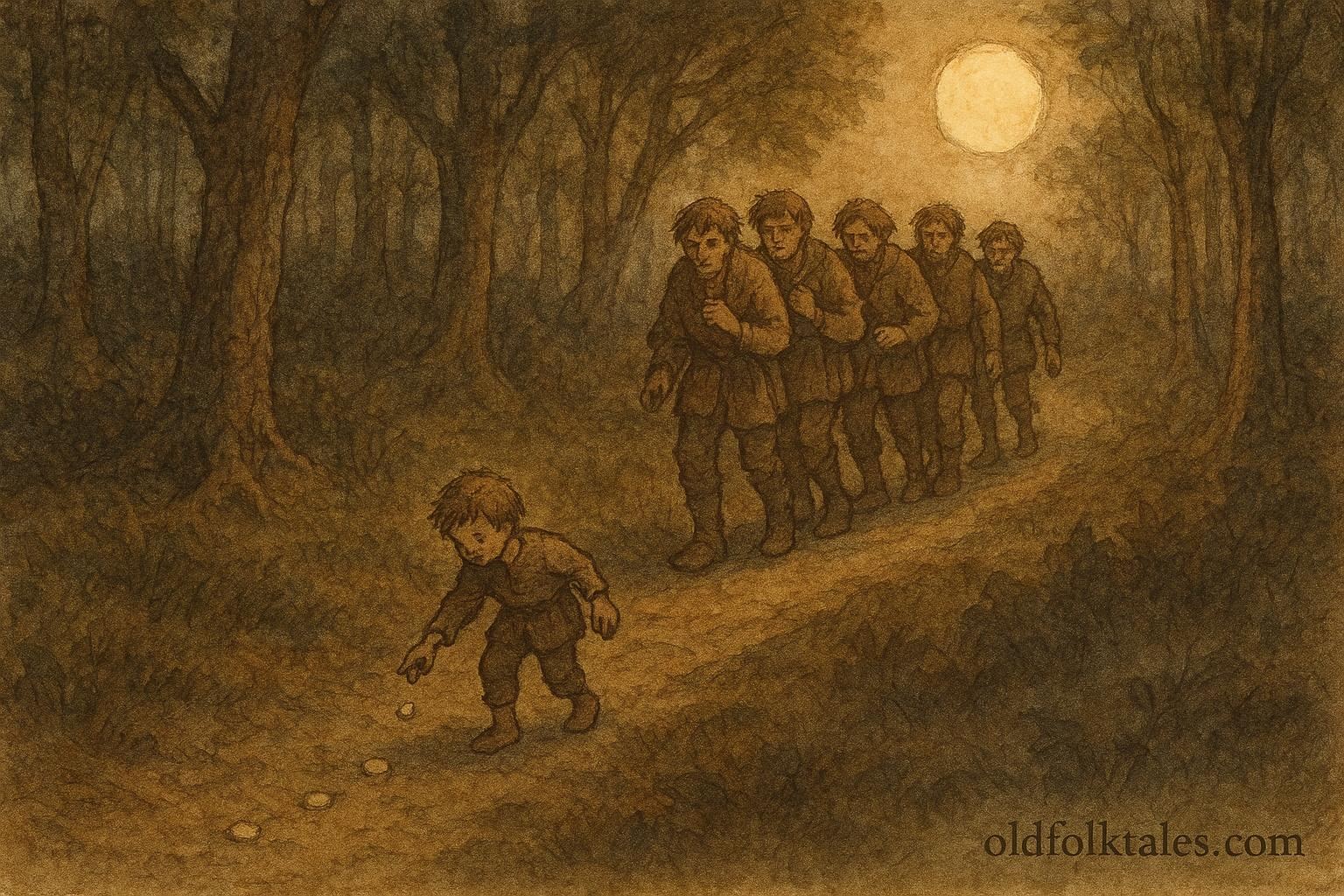
The next morning, as they were led into the forest, Tom quietly filled his pockets with small white stones he had gathered earlier. As they walked deeper into the woods, he dropped the stones one by one along the path.
The forest grew thick and dark, the air heavy with silence. At last, their parents left them.
The older boys cried out in fear, but Tom remained calm. When night began to fall, he led them back, following the trail of stones that gleamed faintly under the moonlight.
And so, against all odds, they returned home.
When Ingenuity Meets Desperation
But poverty is relentless.
The brief relief of their return did not solve the deeper problem, there was still no food. The parents, driven by desperation, resolved to abandon them once again.
This time, Tom tried to gather stones, but the doors were locked. All he could find were crumbs of bread.
As they walked into the forest once more, he dropped the crumbs behind them, hoping they would guide their way back.
But crumbs are not stones.
Birds swept down from the trees, pecking them away until no trace remained.
When the children tried to return, the path was gone.
They were truly lost.
Into the Unknown
Night fell, cold and unforgiving. The forest seemed alive with whispers and shadows. The boys huddled together, hungry and afraid.
Yet even in that darkness, Tom did not surrender. He climbed a tall tree, straining his small eyes to see beyond the endless stretch of woods.
In the far distance, he spotted a faint flicker of light.
Hope.
Leading his brothers, he guided them toward it. Step by step, they made their way through the tangled forest until they reached a small house.
They knocked.
A woman answered, her face lined with worry. When she saw the children, she hesitated.
“You should not be here,” she said quietly. “This is the house of an ogre.”
The House of Danger
The word sent fear through the boys, but they were too exhausted to turn back. The woman, moved by their condition, allowed them inside and hid them.
Soon, the ogre returned.
His presence filled the house like a storm. He could smell them immediately.
“Flesh,” he growled. “I smell fresh human flesh.”
But his wife pleaded with him, convincing him to wait until morning. Reluctantly, he agreed.
That night, the boys were placed in a room beside the ogre’s daughters. Each daughter wore a crown of gold, while the boys wore simple caps.
Tom lay awake.
He knew morning would mean death.
So, quietly, he rose and switched the crowns from the ogre’s daughters onto his brothers’ heads, placing the caps onto the girls instead.
When the ogre awoke in the night, hungry and impatient, he entered the room in darkness. Feeling the heads, he mistook his daughters for the boys, and in his blind hunger, he struck them down.
Tom waited until silence returned. Then he woke his brothers, and they fled into the night.
The Final Escape
By dawn, the ogre realized his terrible mistake. Furious, he put on his enchanted boots, boots that allowed him to travel vast distances in a single stride, and set off in pursuit.
Tom, ever watchful, saw him coming.
When the ogre finally collapsed from exhaustion, Tom approached cautiously. With careful precision, he removed the enchanted boots and placed them on his own feet.
Suddenly, the smallest boy held the power of great speed and distance.
With this advantage, Tom not only escaped, he turned survival into opportunity. In some versions of the tale, he used the boots to work as a messenger for a king, earning wealth and security. In others, he outwitted the ogre entirely, returning home with riches taken from the monster’s hoard.
Either way, he ensured that his family would never face hunger again.
A Story Rooted in Reality
Though filled with fantastical elements, ogres, enchanted boots, and impossible journeys, the heart of this story is deeply real.
In rural France, life for peasants was often harsh. Famine was not a rare occurrence, and difficult choices were sometimes forced upon families.
Tom Thumb reflects these realities, but it does more than that. It offers a message of hope.
Not all strength is physical.
Not all heroes are large.
Sometimes, survival belongs to those who think, adapt, and endure.
Discover the timeless charm of French, Dutch, and Belgian stories filled with cleverness and heart
Moral Lesson
Ingenuity and resilience can overcome even the harshest conditions. No matter how small or overlooked someone may be, intelligence, courage, and quick thinking can change the course of fate.
Knowledge Check
1. Who is Tom Thumb?
The smallest son of a poor woodcutter, known for his intelligence.
2. Why were the children taken into the forest?
Their parents could no longer feed them due to poverty.
3. How did Tom find his way home the first time?
By dropping stones along the path.
4. Why did the second attempt fail?
Birds ate the breadcrumbs he used as markers.
5. How did Tom outwit the ogre?
By switching the crowns and caps, causing the ogre to mistake his daughters for the boys.
6. What is the central theme of the story?
Survival through intelligence and resilience in the face of hardship.
Source: From Histoires ou contes du temps passé (Tales of Mother Goose) by Charles Perrault, 1697.
Cultural Origin: France (rural oral traditions adapted into literary form)