In the quiet east of an ancient Scandinavian valley, where the winters were long and the nights glowed faintly with northern lights, there once stood an old wooden farmhouse surrounded by snow-laden pines. Within this humble home lived a family who, like many in those lands, knew that their peace and prosperity depended not only on their labor, but also on the unseen spirit who guarded their dwelling: the Tomte.
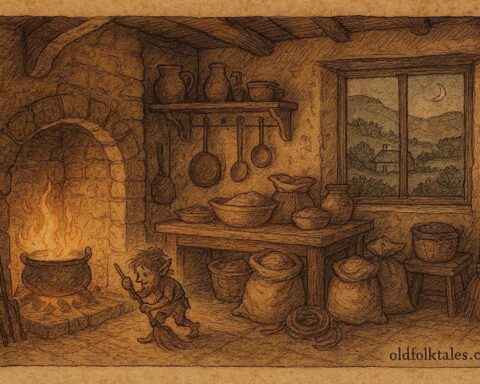
The Tomte was a small, gray-bearded creature, no taller than a child’s knee, dressed in a red woolen cap and a coat the color of the forest moss. Though few ever saw him, every good farmer in Sweden, Norway, or Denmark knew that he was there, watching, working, and protecting. By day he hid in the barn’s shadows, among the hay and animals. By night, when all slept and the stars watched in silence, he made his rounds: checking the stables, mending a broken harness, untangling a calf’s rope, and brushing the horse’s coat until it gleamed.
As long as the farmer treated his home, his animals, and his work with care, and left a bowl of warm porridge with butter for the Tomte on Christmas Eve, all would go well. The crops would thrive, the cows would give sweet milk, and no misfortune would visit the homestead. But if anyone mocked the old traditions, neglected the animals, or forgot the Tomte’s gift, trouble was sure to follow.
One winter, a new farmer took over the estate after his father’s passing. He was strong and proud, but he laughed at what he called “old wives’ tales.” When his wife reminded him to set out the Christmas porridge, he waved his hand dismissively. “Shall I feed ghosts while my cows grow thin?” he scoffed. “If this Tomte exists, he can eat what the animals eat.” And so, instead of warm porridge with a pat of butter, he left the bowl cold and empty.
That night, the barn was silent, too silent. The cows shifted restlessly, and the wind whistled through the cracks. The Tomte, watching from the shadows, felt anger rise within his small but powerful heart. “So,” he muttered, “the new master has forgotten the old ways.” His eyes glowed faintly in the dark, like embers beneath snow.
In the morning, the farmer discovered chaos. The cows had broken their stalls, the horse had thrown its harness, and the chickens refused to lay. The barn, usually a place of peace, was in disarray. The farmer cursed and blamed his workers, never suspecting the spirit’s hand in it.
But the farmer’s wife, a gentle soul who remembered her mother’s teachings, prepared a new bowl that night, steaming porridge topped with golden butter, and quietly set it in the barn. “Dear Tomte,” she whispered, “forgive us. My husband forgot, but we remember.”
When midnight came, the Tomte appeared again. The smell of butter and oats filled the air, soft and sweet. His anger melted like frost under sunlight. He ate the porridge slowly, savoring each bite, then nodded to himself. “This woman remembers,” he said. “For her sake, I will guard this place once more.”
With a wave of his hand, the barn settled into calm. The cows stopped kicking, the horse sighed, and the frost on the beams shimmered with a faint light. When dawn arrived, the farmer found everything neat and well-ordered, and from that day onward, he never again forgot the Tomte’s porridge.
Yet not all Tomtes were so easily appeased. In another village, a careless servant once played a cruel trick. When told to leave porridge for the Tomte, she hid the butter beneath the bowl, hoping to keep it for herself later. The Tomte, believing he had been cheated, ate the porridge without finding the butter and grew furious. He ran to the farmer’s best cow and struck her dead with a single blow. But when he returned to the bowl and saw the butter beneath, shame overcame him. Regretful, he ran to the neighboring farm, took their finest cow, and placed it in the dead cow’s stall, muttering, “May this teach me never to judge too soon.”
Through such stories, people learned that the Tomte was neither wholly kind nor cruel. He was fair. He mirrored the hearts of those he served: kind to the respectful, harsh to the careless. Farmers left his bowl of porridge every Yule, not from fear, but gratitude, for in every home where the Tomte was honored, warmth, order, and quiet prosperity endured through even the coldest winters.
Moral Lesson
Respect for tradition, gratitude for unseen help, and fairness in all dealings bring peace and prosperity. Neglect, deceit, or greed, however small, can turn blessings into misfortune.
Knowledge Check
- Who is the Tomte in Scandinavian folklore?
The Tomte (or Nisse) is a small household spirit who guards farms, animals, and families in Scandinavian tradition. - What offering is traditionally given to the Tomte at Yule or Christmas?
A bowl of warm porridge with butter is left as a sign of gratitude and respect. - What happens when the Tomte is disrespected or forgotten?
He becomes mischievous or vengeful, causing harm or disorder to the household and animals. - How did the farmer’s wife restore peace in the story?
She offered the Tomte a proper bowl of porridge and asked for his forgiveness. - What lesson does the tale of the hidden butter teach?
It warns against deceit and quick judgment, reminding that fairness and honesty are virtues. - Where does the Tomte tradition originate?
It comes from Scandinavian folklore, especially Sweden, Norway, and Denmark.
Source: Adapted from traditional Scandinavian folklore on the Tomte (Sweden) and Nisse (Norway/Denmark) as collected in Norske folkeeventyr and Swedish folklore records.
Cultural Origin: Scandinavia (Sweden, Norway, Denmark).