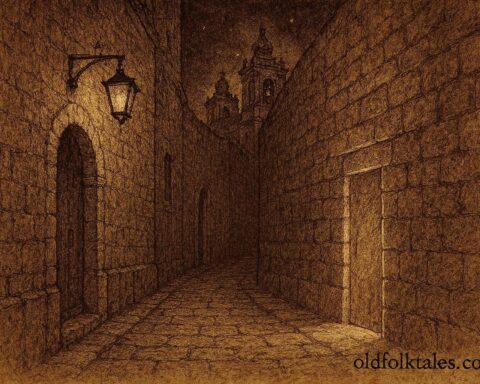
Once upon a time, in a far‑away Albanian kingdom nestled among green hills and shimmering rivers, there dwelt a king who had three daughters, each fairer than the last. When the king passed away, a new sovereign ascended the throne and issued a curious decree: that on the night of his coronation no household should leave a single lamp lit. He then, under cover of darkness, masked his identity and wandered the streets of the capital to see his subjects. As he walked past the home of the three princesses, he overheard the maiden daughters speaking in low voices. The eldest said boldly, “If the king should marry me, I shall weave for him a carpet so vast that his entire army might sit upon it, and there would still be space left over.” The second offered, “If the king married me, I would pitch for him a tent large enough to shelter his entire army, and still more.” Then the youngest spoke with a gentle confidence: “If the king should take me as his bride, I will bear him a son and a daughter whose foreheads will bear stars and whose bosoms will bear crescents.”
As he walked past the home of the three princesses, he overheard them speaking in low voices. The eldest said boldly, “If the king should marry me, I shall weave for him a carpet so vast that his entire army might sit upon it, and there would still be space left over.” The second offered, “If the king married me, I would pitch for him a tent large enough to shelter his entire army, and still more.” Then the youngest spoke with a gentle confidence: “If the king should take me as his bride, I will bear him a son and a daughter whose foreheads will bear stars and whose bosoms will bear crescents.”
Intrigued and enchanted, the king summoned the three sisters the following morning. He married them all. True to their word, the eldest wove the mighty carpet, the second fashioned the great tent, and the youngest soon became pregnant, her promise swelling in the air like the moon rising at twilight.
When the day of her giving birth arrived, the king rode forth on his horse, and his absence sealed his fate. The two elder sisters, envious and cunning, seized the moment. They confronted the king on his return and said: “Your wife has borne, only a kitten and a mouse.” In disbelief and anger, the king condemned his youngest wife to sit on the palace steps exposed to the spittle of all passers-by.
Meanwhile the sisters had placed the newborn boy and girl (the true children, with stars upon their foreheads and crescents upon their breasts) into a wooden box and ordered a servant to cast them into the nearby river. A strong wind rose that day: it carried the box across the current to a solitary mill by the riverbank, where an aged man and his wife lived. The old woman discovered the box, opened it, and stood in awe at the radiant twins. She and her husband reared them with gentle care.
When the old woman died, and afterward the old man, he called the youth to his bedside and said: “My son, in the cave yonder you will find a bridle, but do not enter the cave until forty days have passed.” The youth obeyed. On the fortieth day, he entered the cave, found the bridle, and when he laid his hand upon it and whispered, “I wish I had two horses,” two fine steeds stood before him. He and his sister mounted the horses and rode toward the city where their father reigned.
In the city the youth opened a coffee house, welcoming and full of laughter. His sister remained quietly at home. One day the king came into the coffee house and saw the youth, radiant and noble, with a shimmering star upon his forehead. He returned home later than usual, and on arrival his elder sisters asked why. The king replied, “I encountered a youth in the coffee house: never in my life have I seen such beauty, and he even bears a star on his forehead.”
Hearing this, the two sisters recognized immediately the youth as the true son of the youngest wife. Rage and jealousy burst in their hearts like storm-clouds. They schemed to destroy him. They sent an old woman to the youth’s sister with a whisper: “Your brother cares nothing for you. He stays all day in the coffee house enjoying himself. If he truly loved you, he would bring you a flower from the Earthly Beauty.” That night, when the youth returned, his sister wept. He asked why, and she answered: “You can go free all day, yet I remain idle here alone. If you loved me, you would bring me a flower from the Earthly Beauty.” He took the bridle and his horse, and rode off in search of the Earthly Beauty.
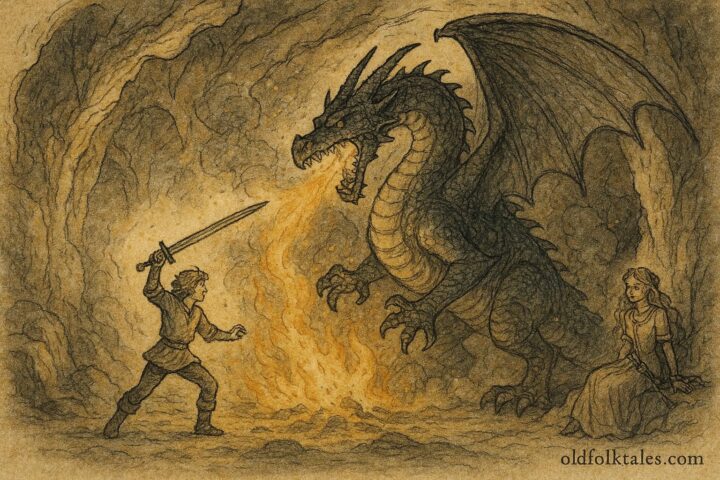
On his journey he encountered first a Kulshedra (a dragon‐like creature from Albanian lore). It refrained from devouring him, deeming his beauty too exquisite. But the Kulshedra did not know where the Earthly Beauty dwelt and directed him instead to its elder sister, who likewise could not help him. At last he reached the eldest sister, who, though she planned to kill him, spared him after seeing his handsome face, and gave him directions: “At the house of the Earthly Beauty you must rub the door with your scarf and when you enter you will find a lion and a lamb. Throw brains to the lion and grass to the lamb, and you will pass.”
He did so: rubbed the door, it opened, he flung brains to the lion and grass to the lamb; they let him pass. He entered the chamber of the Earthly Beauty and stole a single flower. He brought it home, his sister rejoiced. But the sisters’ envy was not yet satisfied. The old woman returned, telling the sister that a scarf belonging to the Earthly Beauty would bring even greater joy. So the youth ventured out again. When he reached the palace and the Earthly Beauty’s chamber, he stole her ring while she slept; awaking, she found him master of her power and came with him willingly.
One morning the king visited the coffee house again and upon returning ordered a feast in honour of the youth and his family. The two jealous sisters bribed the palace cooks to poison the food. But the youth, his sister and the Earthly Beauty refused all but two spoonfuls of the king’s stewed prunes. During the feast the king suggested each guest tell a story. When the youth’s turn came, he recounted his life: his miraculous birth, his hidden upbringing, his adventurous quests. At that moment the king realised that this was the son of his youngest wife, and summoned her back. The two elder sisters were punished, they were drawn and quartered. The youth became the king’s successor, and they all lived in peace and honour.
Moral Lesson:
Even when the world seems to conspire against the innocent, truth and virtue will prevail. Jealousy may blind the hearts of wrong-doers, but steadfast courage and faith in what is right restore dignity and justice.
Knowledge Check
- Q:What promise did the youngest daughter make when she spoke of the children she would bear?
A: She promised she would bear a son and a daughter who would have stars on their foreheads and crescents on their breasts. - Q:How did the two older sisters betray the youngest wife?
A: They claimed her children were a kitten and a mouse, ordered her to sit humiliated on the palace steps, and cast the twins into the river in a wooden box. - Q:How did the youth discover his heritage and win recognition by the king?
A: He grew up with the old miller’s child, opened a coffee house in the capital, caught the king’s attention by his beauty and star-mark, recounted his life story, and thus the king realised he was the rightful son of the youngest wife. - Q:What quests did the youth undertake to win the favour of his sister and prove his worth?
A: He fetched a flower and later the ring (and scarf) belonging to the Earthly Beauty, overcoming the trials set by the Kulshedras and passing the lion and lamb. - Q:What cultural origin does this folktale have, and under what classification of fairy tale type is it grouped?
A: It is an Albanian folktale, collected by Auguste Dozon and translated by Robert Elsie. It is classified under the Aarne-Thompson-Uther tale type ATU 707 (“The Three Golden Children”). - Q:What is the central symbolic meaning of the stars on the foreheads and crescents on the breasts in the story?
A: They symbolize the wonder and exceptional destiny of the children, marks of royalty, truth, and purity, highlighting the theme that true worth will shine despite deceit and theft.
Cultural Origin: Albania (Albanian folklore)