In a narrow valley where pine forests climbed the hillsides and the wind carried the smell of woodsmoke year-round, there lived a poor farmer with his three sons. The house was small, its walls darkened by age and soot, and its hearth burned almost constantly, for the winters were long and unforgiving.
The two elder sons were strong-backed and loud-voiced. They rose early, sharpened their tools with pride, and spoke often of the great deeds they would one day accomplish. They believed firmly that the world rewarded boldness and that success belonged to those who demanded it.
The youngest son was different.
He sat most days by the hearth, poking the ashes with a stick, listening more than speaking. His clothes were always gray with soot, his hair uncombed, his posture relaxed as though he carried no urgency within him. Because of this, his brothers called him Askeladden, the Ash Lad, and they spoke his name as if it were a judgment.
“Go fetch water,” they would say.
“Go mind the fire,” they would laugh.
“You’ll never be anything more than ashes.”
The Ash Lad did not argue. He smiled faintly and did as he was told.
The King’s Proclamation
One winter morning, when frost glazed every branch and the sky was pale as iron, news reached the valley: the king had issued a challenge.
At his palace, the king had grown weary of boastful men and hollow wisdom. He declared that any man who could answer his riddles and speak wisely would be rewarded with wealth and honor, and perhaps even a place in royal service.
The elder brothers were certain this was their chance.
“Riddles are nothing,” said the eldest. “Strength of mind runs in the family, except, of course,”
He glanced at the hearth.
The second brother laughed.
“Stay home, Ash Lad,” he said. “Mind the fire while real men seek fortune.”
The Ash Lad said nothing, but when the brothers set out, he quietly rose, brushed the ashes from his knees, and followed.
On the Road
The road to the king’s palace was long and winding, cutting through forest and over frozen streams. The brothers walked swiftly, eager to arrive first.
Before long, they came upon an old man sitting by the roadside. His cloak was threadbare, his beard white as snow, and his eyes bright despite the cold.
“Good day, young men,” the old man said. “Could you spare a bit of food?”
The eldest brother frowned.
“We have no time for beggars,” he said. “Fortune waits for no one.”
They walked on.
A little farther, they encountered another traveler, this one bent with age, struggling beneath a bundle of firewood.
“Help me lift this,” he asked.
The second brother scoffed.
“We have our own burdens,” he said.
They hurried ahead.
When the Ash Lad reached the same places, he stopped both times. He shared his small bread with the first man and helped the second lift the wood.
“Thank you,” the old man said softly.
“You’ll remember this,” said the traveler, smiling strangely.
The Ash Lad nodded, unsure why their words lingered with him.
Arrival at the Palace
The king’s palace stood high on stone foundations, its roof heavy with snow, its halls echoing with voices. Men from every corner of the land had gathered, rich farmers, merchants’ sons, warriors with gold-hilted swords.
The elder brothers pushed forward confidently.
When the king appeared, silence fell.
He was an old man, stern-faced, his eyes sharp as frost. He surveyed the crowd and spoke.
“Many come here full of pride,” he said. “Few leave with wisdom. Let the questioning begin.”
The Failure of the Proud
The eldest brother stepped forward first. The king asked him a simple question about the world and its workings, about cause and consequence, about what truly lasts.
The brother answered quickly, confidently, and wrongly.
The king dismissed him without anger, but without mercy.
The second brother tried next. His answers were clever sounding but hollow. He spoke much and said little.
The king sighed.
“Words without understanding are like bells without clappers,” he said.
The brothers were sent away, their faces red with shame.
The Ash Lad Steps Forward
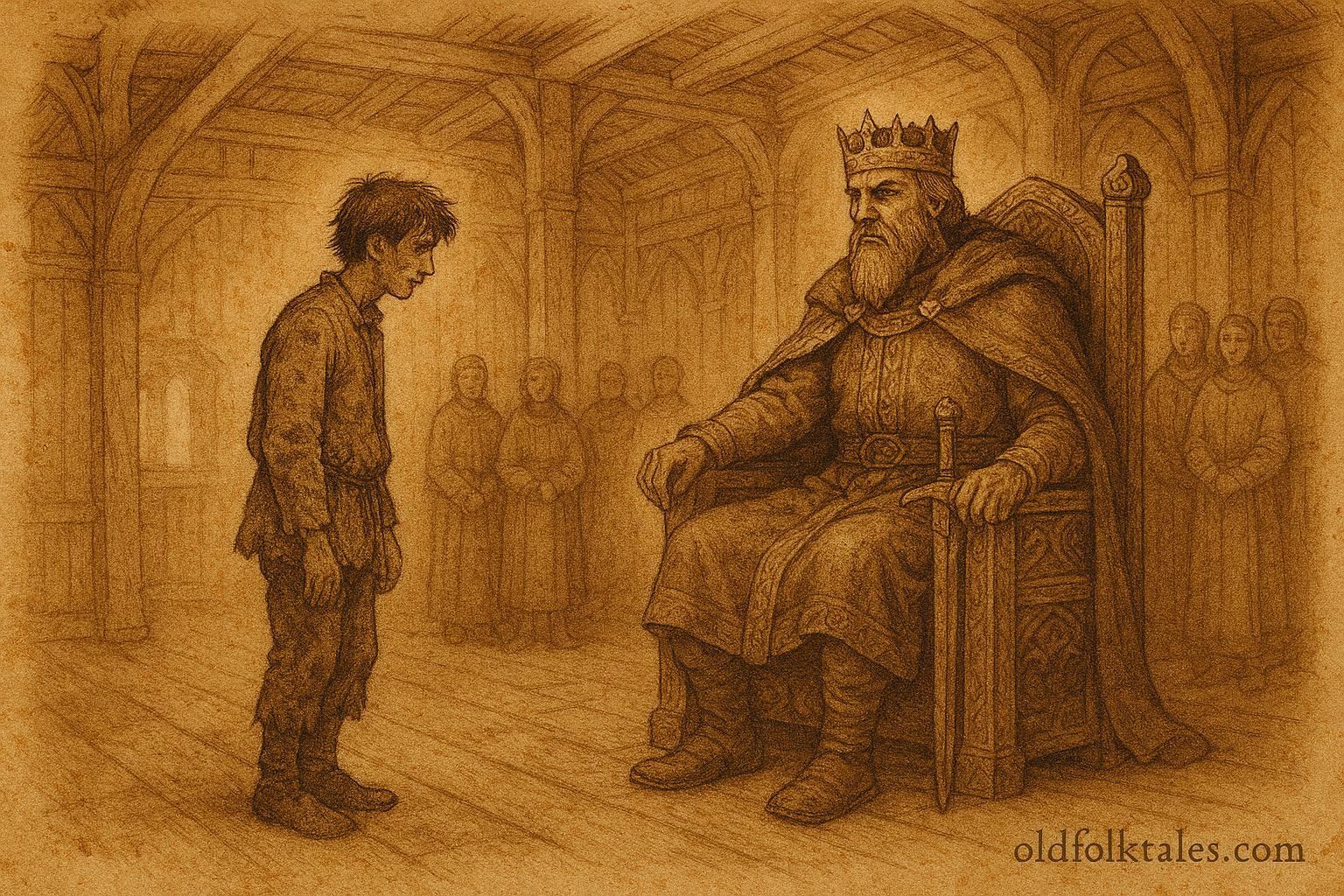
Last came the Ash Lad.
He stood quietly before the king, soot still clinging to his sleeves.
The court murmured.
“Is this a joke?” someone whispered.
The king raised his hand for silence.
“Tell me,” the king said, “what is the lightest thing in the world?”
The Ash Lad thought of the old man on the road, of the traveler’s smile, of the wind moving through the valley.
“A thought,” he said softly. “For it can cross mountains in an instant.”
The king nodded.
“What is the strongest thing?”
“Time,” the Ash Lad replied. “It wears down stone and kings alike.”
The murmurs grew louder.
“And what is the richest thing a man can own?”
The Ash Lad paused.
“A good name,” he said. “For it feeds you even when your table is empty.”
The hall fell silent.
The King’s Judgment
The king rose from his throne.
“You have answered not with pride,” he said, “but with understanding. Tell me, where did you learn such wisdom?”
The Ash Lad bowed his head.
“From listening,” he said. “To people, to the road, to the fire.”
The king smiled, just slightly.
“Then you shall not return to the ashes,” he declared. “You shall be rewarded.”
Gold was brought forth. The Ash Lad was given fine clothes and a place of honor among the king’s household.
His brothers stood at the edge of the hall, silent now.
The Return
When the Ash Lad returned to the valley, he did not boast. He rebuilt the house, cared for his father, and welcomed travelers as he once had been welcomed.
The hearth still burned, but now it warmed a home filled with respect.
Moral Lesson
Wisdom grows in silence, kindness opens hidden doors, and those who listen carefully often rise farther than those who shout.
Knowledge Check
1. Who is the Ash Lad in Norwegian folklore?
The Ash Lad is the youngest, underestimated son who succeeds through wisdom, humility, and kindness.
2. Why do the Ash Lad’s brothers fail at the king’s palace?
They rely on pride and empty cleverness instead of true understanding.
3. What role does kindness play in the Ash Lad’s journey?
His kindness to strangers reflects inner wisdom and prepares him for success.
4. What do the king’s riddles symbolize?
They test character, perception, and moral insight rather than intelligence alone.
5. What is the main theme of the Ash Lad folktale?
True wisdom and humility triumph over pride and social status.
6. What cultural values does this folktale reflect?
Norwegian values of modesty, listening, moral intelligence, and social mobility.
Source: Peter Christen Asbjørnsen & Jørgen Moe, Norske Folkeeventyr, 1841
Cultural Origin: Norway (Norwegian oral folklore tradition)