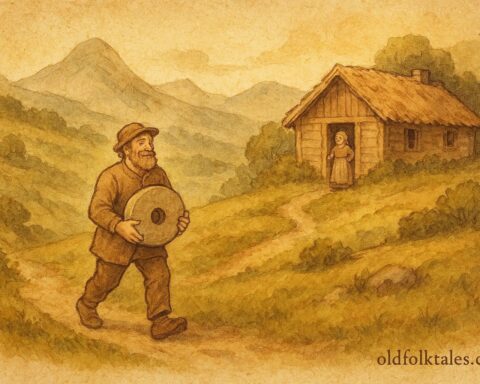
In a quiet valley tucked between Norway’s soaring mountains, where mist often clung to the pine-covered slopes and crystal-clear streams tumbled over rocks, there lived a poor farmer. His homestead was modest, a small wooden house with a thatched roof, a few meager fields, and a barn that had seen many winters. Though he had little wealth, he possessed a sharp mind and a courage that many villagers quietly admired.
The farmer’s neighbors were strong and ambitious men, yet he often outwitted them with careful thought and cleverness. He tilled his fields with determination, repaired his fences with ingenuity, and, more importantly, observed the world around him with a keen eye. Though the villagers sometimes mocked his humble status, they could not deny his cleverness.
Discover the spiritual depth and wisdom hidden in the ancient folklore of Eastern and Balkan Europe
One evening, as the farmer sat by his hearth, the wind howling through the mountains, a traveling storyteller arrived at his home. The man’s cloak was damp, his boots caked in mud, and his eyes sparkled with the thrill of the tale he carried. He spoke of a troll who dwelled in a dark cavern deep in the mountains, a creature feared by all for its enormous size and dangerous temper.
“This troll,” the storyteller said, leaning close so the firelight caught the lines of his face, “owns a magical hammer of great power. It can crush rocks, summon storms, and strike fear into any man foolish enough to approach unprepared. Whoever possesses it gains not only wealth, but respect across all the valleys of Norway.”
The villagers listening murmured, their faces a mixture of awe and disbelief. Such a quest was far beyond ordinary men. But the farmer’s eyes gleamed. “A hammer like that,” he murmured to himself, “might change my life, and I have wit enough to claim it.”
At dawn, the farmer packed a small bundle. He carried bread, cheese, a rope, and a piece of cloth, along with his most trusted walking stick. He left his home quietly, taking the winding path that led into the dense, shadowed forests at the base of the mountains. Birds flew overhead, and deer scattered at his approach, as if nature itself sensed the danger that lay ahead.
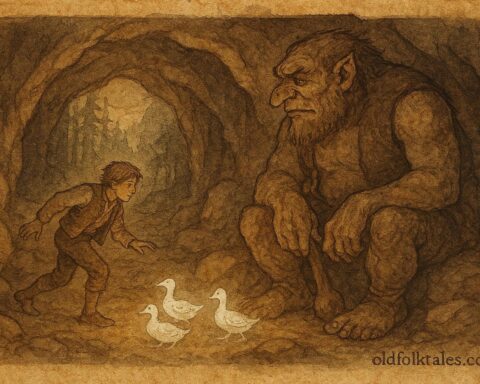
After a long day of climbing and navigating treacherous ridges, he arrived at the mouth of the troll’s cavern. The entrance was vast, dark, and foreboding, carved into jagged rock that jutted out like the teeth of a great beast. From deep within the cave came the faint sound of a low, rumbling snore. Sunlight faded behind him as he stepped cautiously forward, the weight of the adventure pressing upon him.
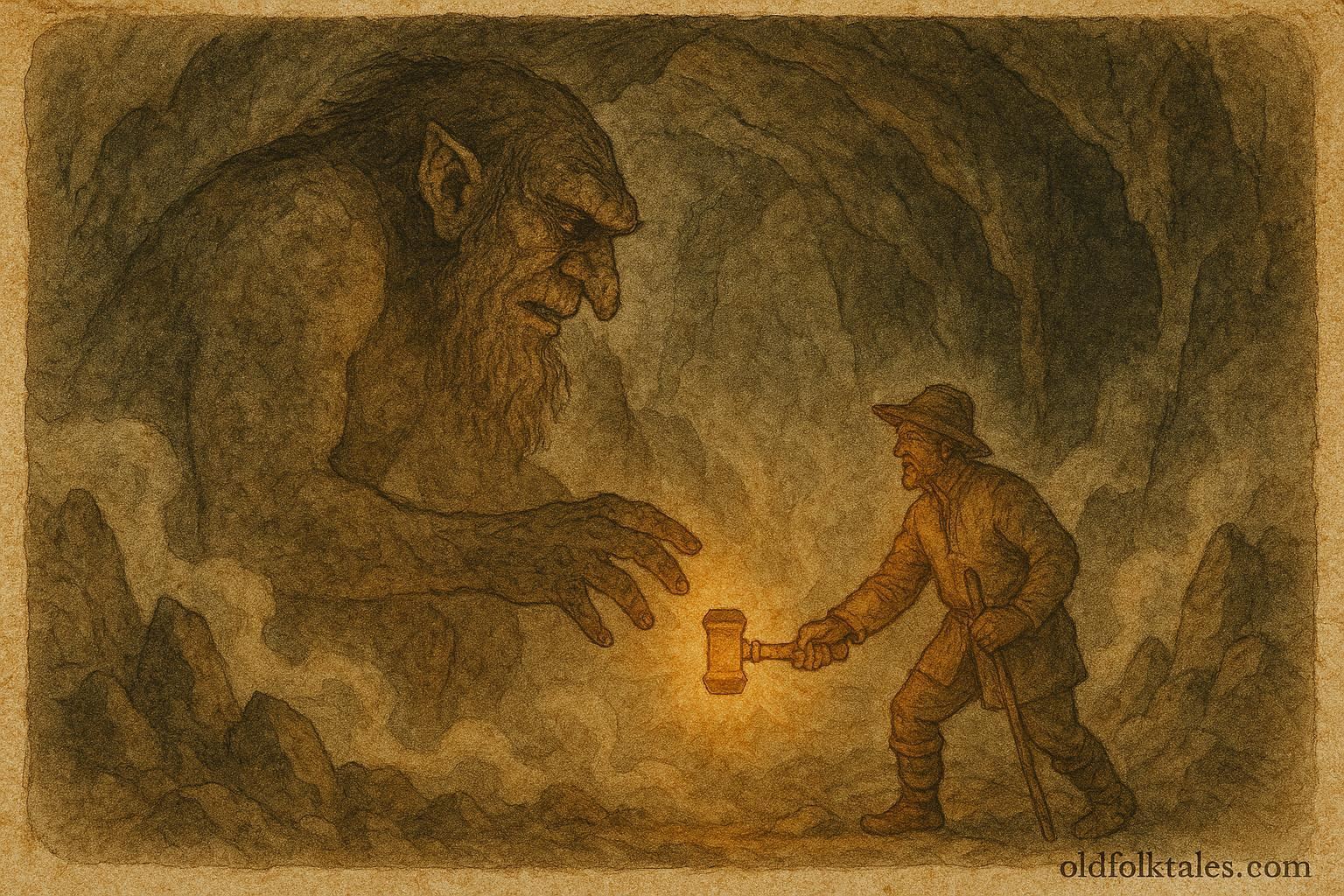
Inside the cavern, the troll sat upon a massive stone, its skin rough and bark-like, its eyes glowing faintly in the dim light. The magical hammer rested beside it on a pedestal of stone, faintly shimmering with a mysterious power. The creature’s breath filled the cavern with a sulfurous scent, and the echoes of its snore bounced ominously along the walls.
The farmer’s heart raced, but he remembered the storyteller’s advice: wit and courage would serve him better than strength. He crouched low and began to observe. The troll, enormous and clumsy, often turned its attention to its surroundings, sniffing and grumbling when it sensed movement. The farmer saw that the creature was proud, easily distracted by oddities, and quick to underestimate anyone smaller or quieter than itself.
He waited until the troll settled into a deep snore again. Then, using a small stone, he tapped the cavern wall, creating a soft echo. The troll twitched its head but did not rise. Encouraged, the farmer tossed another stone, making it skitter across the cavern floor. The creature’s massive eyes opened, glowing with curiosity.
“Who dares disturb me?” the troll growled, its voice like rolling boulders.
The farmer stepped forward, bowing respectfully. “Great troll,” he said, “I mean no harm. I seek only to test my mind against yours and perhaps borrow your hammer for a worthy purpose.”
The troll’s eyebrows rose. “A human, and bold enough to speak to me? Why should I trust you?”
“I offer only my wit,” the farmer replied calmly. “A sharp mind can be a friend even to the strongest troll.”
Intrigued, the troll allowed him to come closer, its curiosity piqued by the human’s audacity and calm.
The farmer began his plan. He placed the rope over the pedestal where the hammer lay, tying it carefully to his walking stick, and used the cloth to mask the glimmering metal as he slowly inched it toward him. He spoke softly, keeping the troll’s attention occupied with questions about its strength and stories of its exploits, appealing to its pride.
“Tell me, mighty troll,” he said, “how did you come to claim such a wondrous hammer? Surely only a being of great cleverness could wield it so well.”
The troll puffed up with pride, launching into a long story of its adventures, how it had defeated rival trolls, and how no human had ever dared approach. All the while, the farmer worked deftly, inching the hammer closer to himself.
Finally, the hammer was within reach. With a swift and precise movement, the farmer grasped it by the handle. The troll turned just in time to see the glint of the magical metal. It roared in rage and swung its massive arms, but the farmer had anticipated this. He used the rope to vault backward, dodging the troll’s clumsy, thunderous strikes.
“Wait!” the farmer called. “I mean no harm! Take pride in my courage, for I have acted with respect. The hammer is yours, yet my cleverness has won it fairly!”
The troll paused, surprised by the man’s calm demeanor and clever execution. In that moment, it realized that the farmer had not acted dishonorably; he had used wit, observation, and skill. Slowly, the creature nodded, acknowledging the farmer’s cleverness without admitting defeat.
The farmer left the cavern, the magical hammer in his hands. As he descended the mountain, he felt a new sense of respect from the world around him. Villagers who once doubted him now whispered of his bravery and intelligence. He returned to his humble farm, where the hammer brought him not only wealth but the admiration of all who heard the tale.
With the hammer, he strengthened his fields, built better tools, and shared his fortune generously. Yet he never boasted, knowing that true greatness came from courage, careful thought, and respect for others, even those as fearsome as a troll.
Over time, the story of the troll’s hammer spread far and wide. Parents told it to children not as a tale of magic alone, but as a lesson: intelligence, courage, and cleverness could overcome strength and danger. The farmer’s success was measured not only by wealth but by the respect he earned and the wisdom he demonstrated. He had proven that a humble man, guided by wit and moral judgment, could triumph over forces much larger and more fearsome than himself.
And so, the mountains, forests, and valleys of Norway echoed with the tale of the poor farmer who had outsmarted a troll and claimed the magical hammer, a story of ingenuity, courage, and moral justice that inspired generations.
Moral Lesson
This Norwegian folktale teaches that courage and intelligence are more powerful than brute strength. By acting with wit, patience, and moral insight, even the humblest person can overcome great challenges and gain respect.
Knowledge Check
- Who is the protagonist of “The Troll’s Hammer”?
A clever and brave poor farmer from Norway who outwits a powerful troll. - What magical item does the troll own?
A magical hammer capable of crushing rocks, summoning storms, and instilling fear. - How does the farmer acquire the hammer?
Through observation, clever distraction, and careful planning rather than brute force. - Why does the troll eventually allow the farmer to keep the hammer?
The troll is impressed by the farmer’s ingenuity, bravery, and respectful approach. - What are the main themes of the story?
Cleverness, courage, ingenuity, moral justice, and triumph of intelligence over strength. - What does the troll symbolize in Norwegian folklore?
Raw power and danger that can be overcome by wit, courage, and careful planning.
Source: Norske Folkeeventyr (1850)
Cultural Origin: Norwegian folklore