In a small Norwegian village surrounded by dark pine forests and long, winding rivers, there lived a boy who was unlike any other. From childhood, he showed no fear, not of storms that split the sky, nor of wolves whose howls echoed from the hills, nor of the deep winter nights when shadows pressed close to the hearth.
When others shuddered at stories of trolls lurking in the mountains or spirits wandering abandoned farms, the boy listened with calm curiosity. He could not understand why his heart remained still while others trembled.
“I want to learn what fear is,” he said often. “People speak of it as though it were a teacher. But I have never met it.”
His neighbors shook their heads. Some laughed. Others warned him that fear was not something to seek. But the boy was stubborn in his simplicity. He believed that to live fully, he must know all that a human heart could feel.
At last, he made his decision.
“I will go north,” he declared, “where the nights are longer, the forests deeper, and the dangers real. If fear lives anywhere, it must live there.”
With little more than a bundle of bread and his walking stick, the boy set out alone.
Into the Northern Wilds
As he traveled north, the land grew harsher. The forests thickened, and the air turned sharp with cold. Mountains rose like dark sentinels against the sky, their peaks hidden by drifting cloud.
At night, he slept beneath trees or in abandoned shepherd huts. Strange sounds moved through the darkness, branches snapping, distant voices carried by the wind, but the boy slept soundly.
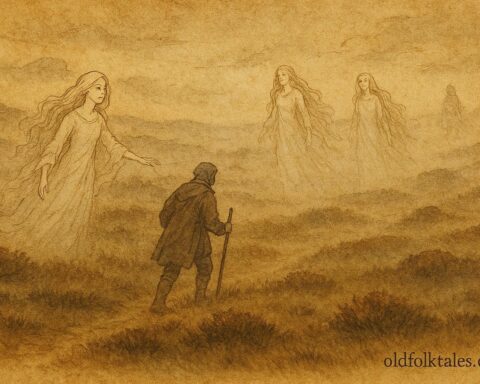
One evening, he came upon a farm long left to ruin. The roof sagged, and the door hung crooked on its hinges. The villagers had spoken of such places, saying that spirits gathered where humans no longer lived.
“This seems a good place to learn fear,” the boy said.
He lit a fire and sat by it, waiting.
At midnight, the door creaked open by itself. A pale figure drifted across the floor, its feet never touching the ground.
“Boo,” whispered the ghost.
The boy looked up calmly. “You should wear warmer clothes,” he said. “You look cold.”
The ghost stared, uncertain, then vanished into the dark.
The boy sighed. “Still nothing.”
The Troll Bridge
The next day, the boy reached a narrow bridge spanning a roaring river. The stones were slick with moss, and mist rose from the water below.
Halfway across, the bridge shook.
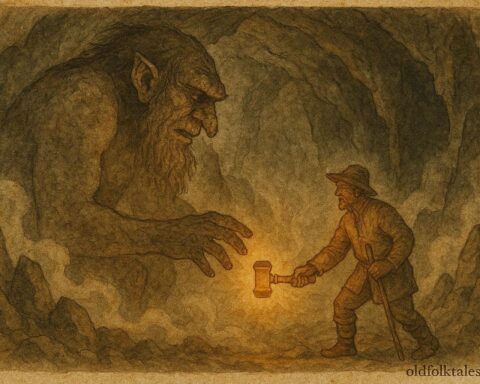
From beneath it rose a troll, huge and gray, with a nose like a boulder and eyes glowing like embers. Its voice rumbled like distant thunder.
“Who dares cross my bridge?”
The boy met the troll’s gaze. “I am going north to learn fear.”
The troll bared its teeth. “Then I shall teach you.”
It lifted a massive arm, but the boy merely stepped aside, letting the troll’s blow strike the stone railing instead. The bridge cracked, and the troll howled in pain.
“You should be careful,” the boy said. “You nearly fell in.”
Confused and angry, the troll retreated beneath the bridge.
Once again, the boy crossed without fear.
The Haunted Church
Farther north, he came to a church that stood empty, its bell silent for generations. People said that no one who stayed there overnight returned unchanged.
The boy entered at dusk and sat beneath the tall wooden rafters. As the night deepened, the air grew cold. Shadows stretched and twisted. Coffin lids creaked open, and bones rattled across the floor.
A chorus of voices rose in the darkness.
The boy gathered the scattered bones and stacked them neatly. “You’ll never rest if you leave things lying about,” he said.
The noises stopped.
By morning, the church was silent again.
“I must be missing something,” the boy muttered as he left.
The King’s Challenge
Eventually, the boy reached a great hall where a king ruled the northern lands. The king was troubled, for his castle was haunted, and no one dared stay within it overnight. Many had tried. None had succeeded.
When the boy heard this, his eyes lit up.
“Let me stay there,” he said. “Perhaps I will learn fear at last.”
The king agreed, promising a great reward if the boy survived the night.
At sunset, the boy entered the castle alone.
The Night of Trials
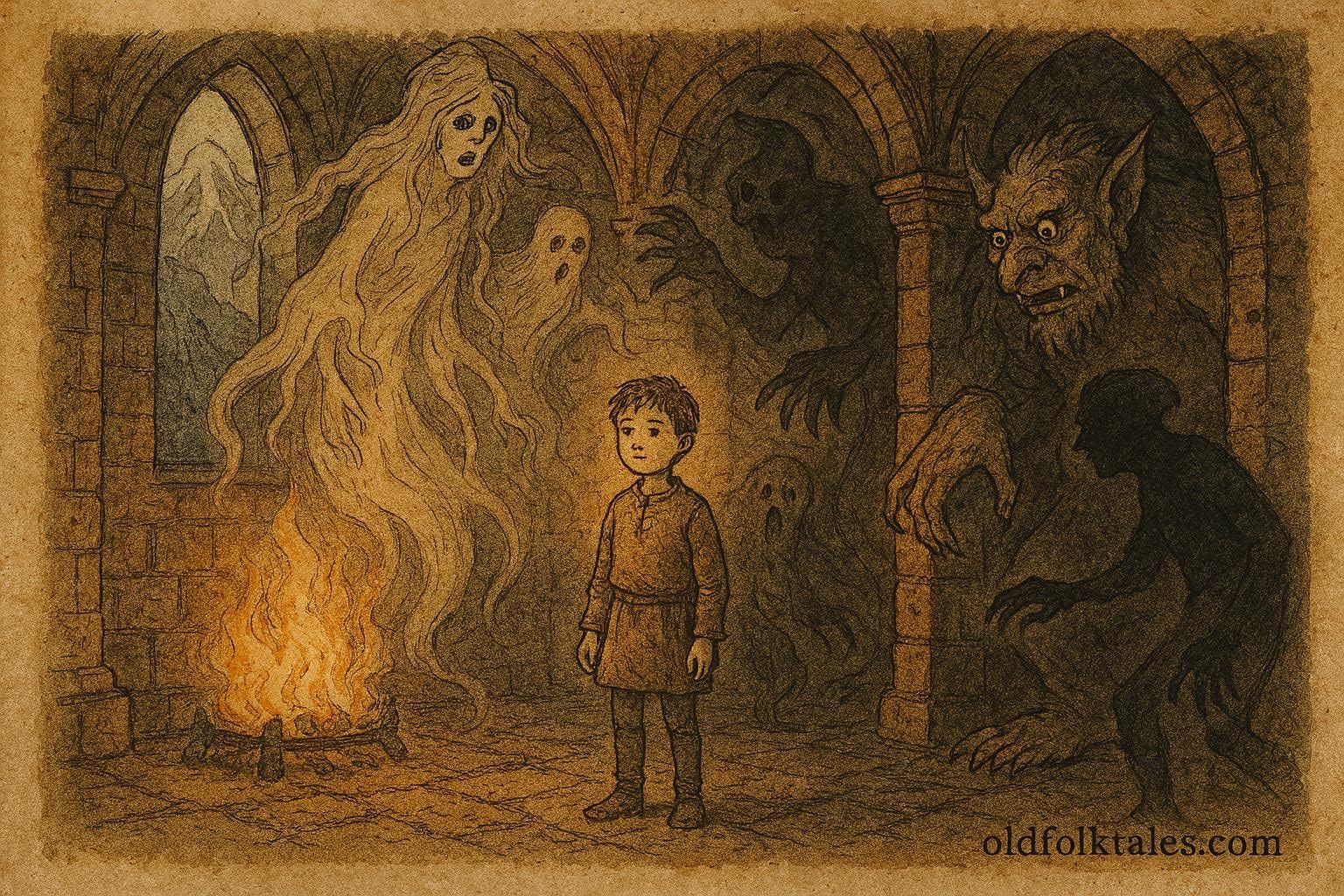
As the fire burned low, the castle came alive.
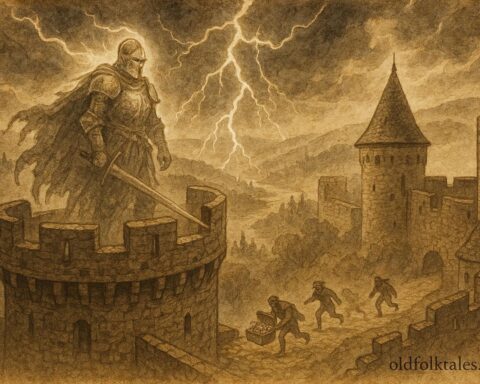
Chains dragged across stone floors. Cold hands brushed past him. Dark shapes crept along the walls. A headless figure rolled across the hall, laughing horribly.
The boy picked up the head and set it back on the body. “You dropped this,” he said.
At midnight, a roaring wind tore through the hall, and the floor split open. Creatures clawed their way up, trolls, spirits, and shadow-things all at once.
The boy built up the fire and warmed the hall.
“You’re letting the cold in,” he scolded them.
One by one, the creatures vanished.
By dawn, the castle stood quiet and still.
The king was astonished. The curse was broken.
Yet the boy remained disappointed.
“I still do not know fear,” he said sadly.
The Unexpected Lesson
The king rewarded the boy richly and offered him a place at court. There, the boy married and settled into a life of comfort.
One winter night, as he lay sleeping beside his wife, she grew tired of hearing him speak of fear as something he lacked.
She filled a bucket with icy water and live fish and poured it over him as he slept.
The shock jolted him awake. The cold seized his breath. His heart raced, and his body trembled uncontrollably.
“Oh!” he cried. “So this is fear!”
At last, he understood.
Moral Lesson
Fear is not always found in monsters or darkness. Sometimes, it comes from vulnerability, surprise, and the human heart itself. True growth lies not in seeking terror, but in understanding oneself.
Knowledge Check
1. Why does the boy travel north?
To learn what fear feels like.
2. What creatures does he encounter on his journey?
Ghosts, trolls, spirits, and enchanted beings.
3. Why does nothing frighten him at first?
He lacks emotional understanding of fear, not courage.
4. How is the haunted castle curse broken?
Through calm behavior and practical wisdom.
5. What finally teaches the boy fear?
An unexpected human moment involving cold and surprise.
6. What culture does this folktale belong to?
Norwegian oral folklore.
Source: Norwegian folktale variant related to wider European traditions, Mid-19th century (c. 1840s–1850s)
Cultural Origin: Norway