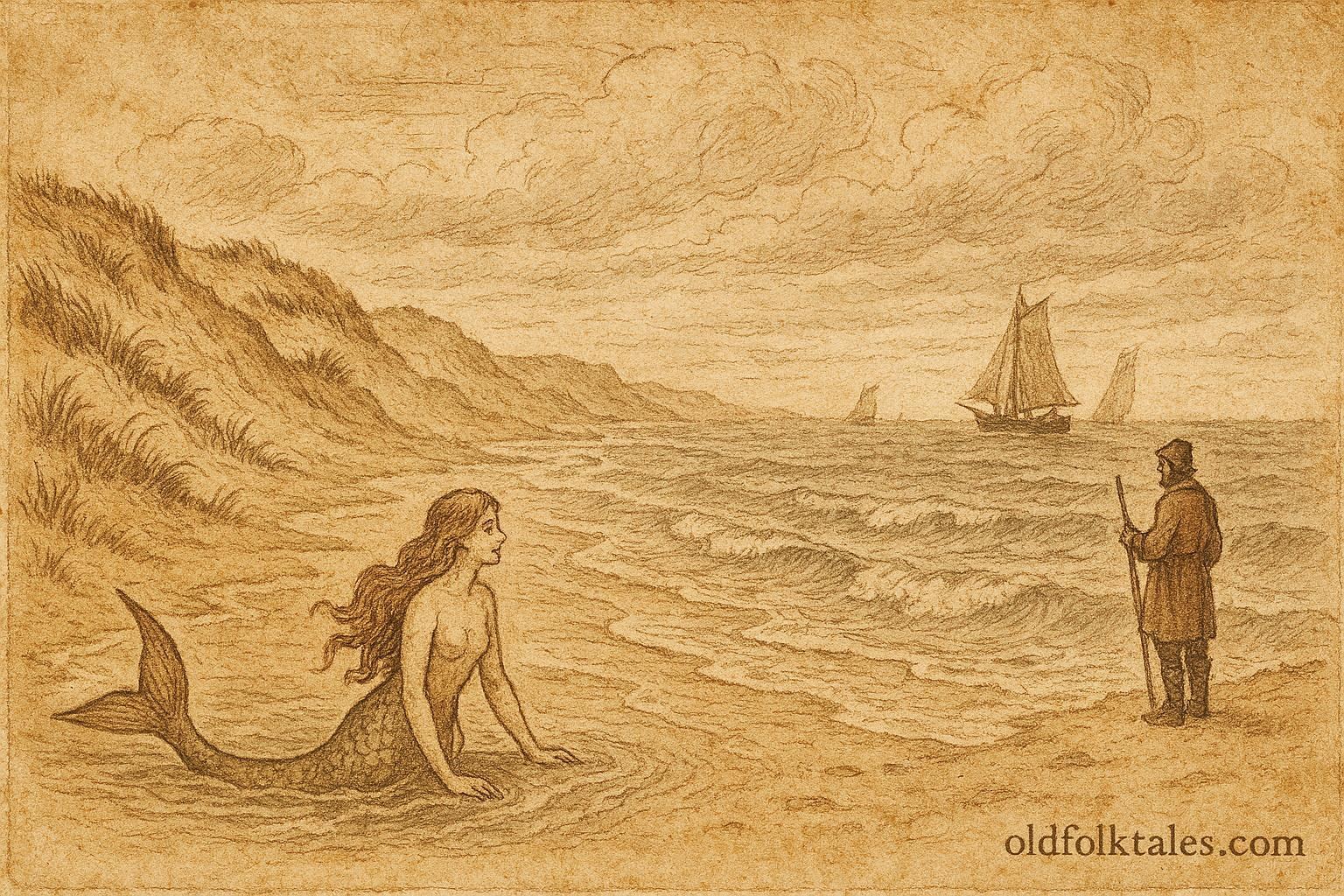
Along the windswept coast of West Flanders, where the North Sea beats relentlessly against dunes and fishing boats sway beneath vast grey skies, the village of Westende has long carried a story whispered between tides. It is a tale born from stormlight and salt spray, a legend of a mermaid who rose from the sea not merely as enchantress, but as guardian, judge, and grieving lover.
Fishermen told it in low voices while mending nets. Mothers repeated it to children when the wind howled against shutters. It was eventually preserved in writing by Alfons de Cock in Vlaamsche Sagen uit den Volksmond (1908), ensuring that the Mermaid of Westende would not be lost to the waves of time.
But long before ink touched paper, the sea itself carried her name.
The Storm-Walker of the North Sea
The North Sea is not a gentle body of water. Along the Belgian coast, storms gather swiftly, sweeping in from distant horizons with little warning. Clouds lower, winds sharpen, and the surface of the sea churns into restless violence.
It was during such storms that the mermaid was said to appear.
Fishermen described her rising from the dark water just beyond the break of the waves. Her hair shimmered like wet seaweed under lightning’s flash. Her eyes reflected depths no mortal could measure. She did not sing as in southern tales of sirens; she spoke rarely, and only when she chose.
To the humble, those who treated the sea with reverence, she offered warning.
More than once, old sailors claimed they saw her silhouette through sheets of rain, her arm lifted toward shore, urging them back. Nets were cut loose, sails lowered, and boats turned just in time. Those who obeyed returned safely, though their catch might be lost.
“The sea gives,” the elders would say, “but it must be respected.”
Yet not all listened.
The Arrogant and the Sea
Some men believed themselves masters of tide and wind. They laughed at omens and scoffed at old stories. When storms approached, they pushed their boats forward, determined to wrest profit from danger.
These were the ones the mermaid did not warn.
Instead, they spoke of glimpsing her further out, closer to the treacherous swells. She did not beckon with tenderness, but with a gaze that stirred pride. Those who followed her shape into deeper waters often found themselves caught in currents too strong to fight.
Boats capsized. Oars vanished beneath foam. And when wreckage drifted ashore, villagers shook their heads solemnly.
“She called him,” some whispered.
But others corrected them: “No. He followed.”
Thus the legend grew: she did not destroy without cause. She answered arrogance with consequence.
The Fisherman Who Saw Her Clearly
Among the fishermen of Westende lived a man known for his quiet ways. He was neither the wealthiest nor the boldest, but he understood the sea’s temper. He cast his nets with patience and returned home content whether the day’s catch was heavy or light.
One twilight, as clouds gathered low and violet across the horizon, he saw her.
Not as a flash between waves, but near the shoreline, where water met sand in silver ripples. She rose slowly, watching him without hostility. There was no storm yet, only the promise of one.
He did not run. Nor did he call out to others. Instead, he removed his cap and bowed his head slightly, as one might greet a stranger deserving respect.
For a moment, the wind softened.
The mermaid regarded him, and in her gaze he sensed neither lure nor warning, only recognition. She slipped back into the sea without a word.
That night, a storm broke fierce and sudden. Remembering her presence, he kept his boat secured and remained ashore. Many who ventured out did not return.
From then on, he watched the sea differently, and sometimes, when dusk fell quiet and pale, she appeared again.
A Love Born of Trust
Legends say that over time, their meetings grew less distant. She rose not only during storms but during calm evenings, when the sea mirrored the sky. The fisherman spoke to her softly, though few words were needed. She listened.
He told her of tides and nets, of hunger and gratitude. She told him nothing of the deep, yet her silence carried meaning.
Their bond formed not from enchantment but from understanding. He did not seek to capture her, nor to boast of her existence. He kept her secret as one guards a sacred thing.
In return, the sea favored him. His nets filled steadily. His boat remained safe even when others struggled.
But prosperity invites attention.
The Seed of Betrayal
Whispers began among other fishermen.
“How does he know when to stay ashore?”
“Why does his catch never fail?”
Pressed by suspicion and tempted by pride, the fisherman made a fatal mistake. One evening in the tavern, warmed by ale and the admiration of others, he hinted at his secret.
He did not speak her name, nor describe her fully. Yet he spoke enough.
“I have… guidance,” he said. “A sign from the sea itself.”
The words spread as quickly as wind over water.
Some laughed. Others demanded proof. And when he next walked to the shore at dusk, he was not alone. Hidden behind dunes and boats, men waited to witness the marvel.
She rose from the sea as she had before.
But this time, she saw them.
Return to the Depths
The mermaid’s expression changed, not with fury, but with sorrow.
The fisherman stepped forward, hands raised in apology, yet no words bridged the distance he had created. Trust, once broken, cannot be mended by explanation alone.
Without warning, the wind strengthened. Waves climbed higher against the sand. The watchers stumbled backward as spray lashed their faces.
She turned away.
For a final moment, she looked toward the fisherman, not with hatred, but with a grief deeper than the sea itself. Then she descended beneath the waves.
She did not rise again for him.
In the days that followed, storms battered the coast with unusual force. The fisherman’s fortune changed. His nets came up empty. His boat narrowly escaped disaster more than once.
He lived long enough to regret his pride, but never again did he see her shape in the tide.
The Lesson of Westende
The Mermaid of Westende was never merely a creature of beauty or terror. She embodied the sea’s character, generous yet unforgiving, protective yet dangerous to the careless.
Her warnings favored humility. Her wrath answered arrogance. And her love required silence and trust.
Along the North Sea coast, fishermen learned to bow their heads before casting nets. They spoke of storms with reverence. They remembered that the sea is not conquered, only navigated.
Even now, when gales sweep across West Flanders and waves climb high against the breakwaters, some claim to glimpse a figure beyond the foam, watching, weighing, deciding.
Whether guardian or avenger depends not on her mood, but on the hearts of those who sail.
Moral Lesson
The Mermaid of Westende teaches that nature demands respect, humility preserves life, and trust must be guarded carefully. Pride and betrayal carry consequences, especially when one forgets the sacred balance between humanity and the sea.
Knowledge Check
1. Where does the Mermaid of Westende legend originate?
From Westende on the Belgian coast in West Flanders.
2. When did the mermaid appear to fishermen?
Primarily during violent storms along the North Sea.
3. How did she treat humble fishermen?
She warned them of danger, allowing them to avoid storms.
4. What happened to arrogant sailors?
They were lured into dangerous waters and often lost to the sea.
5. Why did the mermaid leave the fisherman she loved?
He betrayed her trust by revealing her secret to others.
6. What themes define this Flemish sea legend?
Respect for nature, humility before the sea, betrayal, love, and loss.
Source: Alfons de Cock, Vlaamsche Sagen uit den Volksmond (1908).
Cultural Origin: Flemish (West Flanders, Belgian coast).