In the quiet, fog-draped countryside of Flanders, long before the glow of lanterns lit the winding roads, villagers spoke in hushed tones of a creature known as the Kludde. Its presence was not one of gentle fright but of cunning mischief, a spirit whose purpose seemed to be to torment the unwary and teach a lesson about fear, endurance, and respect for the night.
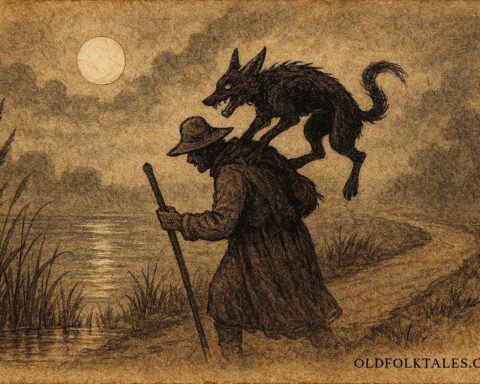
The Kludde roamed the roads and forest paths under the cover of darkness, unseen in daylight but feared by all who knew the tales. Some said it appeared as a monstrous dog, black as midnight, with fiery eyes that glimmered like embers. Others swore it took the form of a large cat, a shadowy horse, or even a towering human figure, shifting its shape to confuse and terrify those it pursued. No matter the guise, its intent remained the same: to leap onto a traveler’s back, invisible or immense, and cling there with relentless weight.
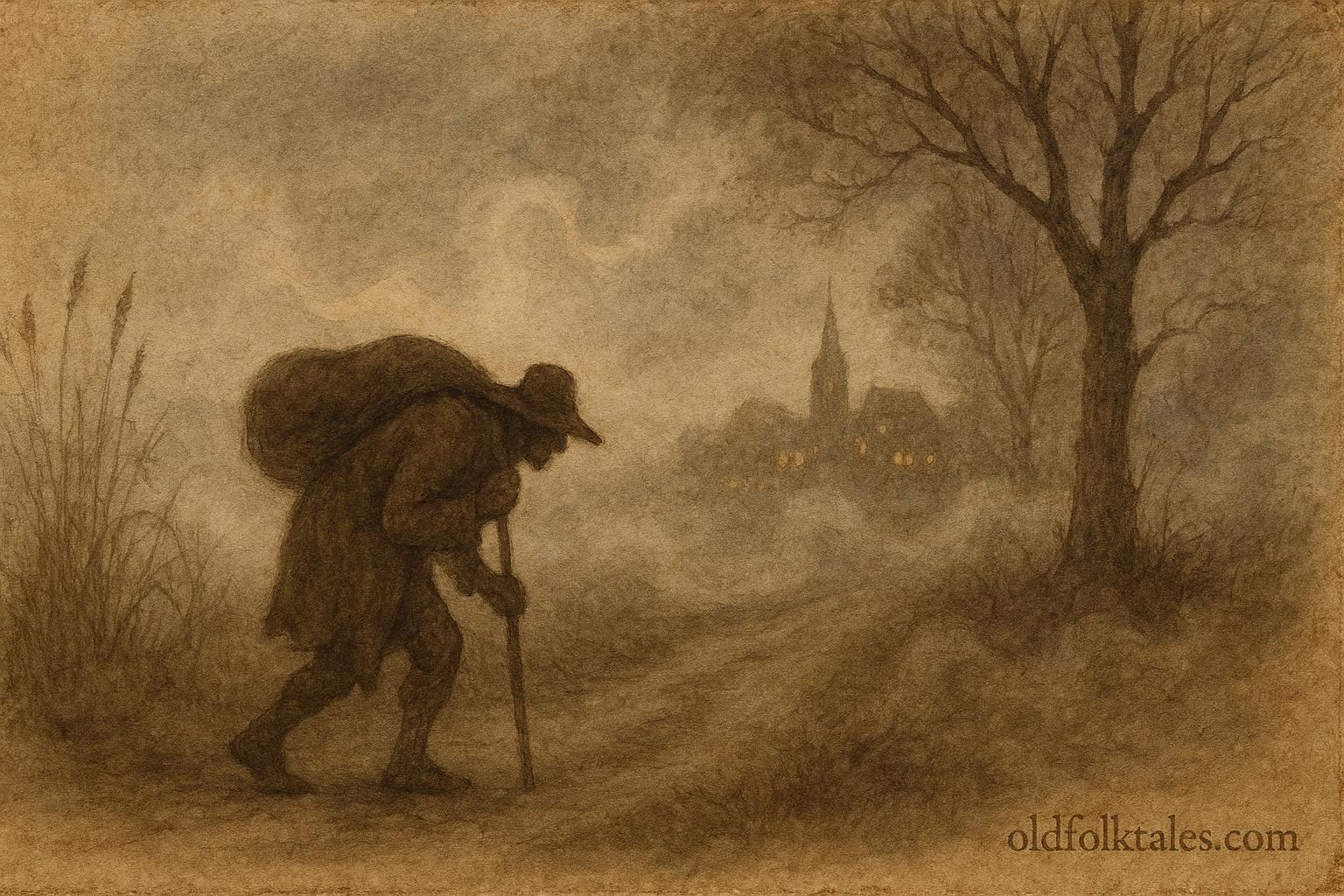
On certain nights, when the mist rolled thick across the fields and the wind whispered low through the reeds, those traveling alone along country lanes would suddenly feel it. The air would grow heavy, and an invisible pressure pressed down upon their shoulders. At first, the sensation might seem like a strange fatigue, but it did not lessen. Step by step, the weight grew heavier, as if some phantom force were riding them, laughing at every strain of muscle and bone.
One such traveler was Jan, a young man from a small village near Ghent. He was strong, proud of his endurance, and, like many of his neighbors, somewhat skeptical of ghost stories. One moonless evening, he set out to deliver a message to a distant farm, walking a narrow path flanked by tall reeds and the dark silhouettes of trees. The night was silent, save for the occasional rustle of animals in the undergrowth.
Hours passed uneventfully. Jan hummed a tune to keep his spirits high, confident in his speed and stamina. But as he rounded a bend near an abandoned stone wall, a sudden chill froze him to the spot. The air felt heavier, thicker than any cold he had known. A pressure descended upon his shoulders, like a weight invisible yet utterly real.
Jan stumbled, his knees bending under the force, and his mind raced with confusion. What unseen creature could be upon him? Fear prickled his skin, but he refused to yield.
“It is only fatigue,” he muttered, gripping his satchel tightly, though he knew in his heart that the weight was something unnatural.
Step by step, the burden grew heavier, pressing down like a sack of stones. Sweat ran down his back and his arms trembled. The air seemed alive with quiet laughter, mocking his struggle, yet no shape could he see.
Then he remembered the stories of the Kludde, tales passed down from elders by the hearth: the shapeshifting spirit, the heavy phantom that rides the unwary, and the salvation of the crossroads. To overcome it, the stories said, a traveler must endure until the journey brought them to the place where paths intersected, where the spirit’s power could break.
Jan gritted his teeth, muscles burning. He would not falter. Step by agonizing step, he moved forward, feeling the pressure growing heavier, as if each heartbeat summoned another layer of weight. His arms ached; his legs threatened to collapse under him. Yet he pressed on, whispering prayers under his breath and recalling every tale his grandmother had told of courage and cunning in the face of spirits.
The night seemed endless, the darkness a living thing pressing against him. And still, he walked.
Finally, ahead of him, a faint outline appeared through the fog, the crossroads. Four paths intersecting under the skeletal limbs of old trees. Jan forced one last step, staggering onto the intersection, his body trembling, his breath ragged.
At that instant, the weight vanished. The invisible burden lifted from his shoulders as though it had never been. The air cleared, the chill withdrew, and the eerie laughter faded into the whispering wind.
Jan fell to his knees, exhausted but victorious. He looked around cautiously, but the path was empty. The Kludde had vanished, unable to hold him at the intersection, its mischief thwarted by endurance and the wisdom of the old tales.
When Jan returned to his village at dawn, he recounted the ordeal in a hushed voice, warning neighbors of the spirit’s tricks. “The Kludde,” he said solemnly, “rides the careless and the unprepared. Only those who know the path, the tales, and the endurance of the night can survive.”
From that day, travelers in Flanders respected the dark paths more keenly, walking in groups, carrying lanterns, and never forgetting the power of the unseen. For the Kludde was not evil in the simple sense, it was a test, a reminder of human perseverance, courage, and the respect owed to the forces lurking in the night.
Moral Lesson
The Kludde teaches that vigilance, endurance, and respect for the unknown are essential. Fear may test the body and mind, but knowledge and perseverance can overcome even the heaviest burdens.
Knowledge Check
- What is the Kludde in Flemish folklore?
Answer: A mischievous, shapeshifting spirit that rides travelers at night. - How does the Kludde torment its victims?
Answer: By leaping onto their backs and growing heavier with each step. - What forms can the Kludde take?
Answer: It can appear as a dog, cat, horse, human, or other shapeshifting forms. - How can a traveler escape the Kludde?
Answer: By enduring the burden until reaching a crossroads, where the spirit’s power breaks. - What is the main theme of the Kludde legend?
Answer: Fear of the unknown, endurance, and supernatural mischief. - Where does the legend of the Kludde originate?
Answer: Flemish folklore, Northern Belgium, documented in Vlaamsch Sagenboek (1843).
Source: Vlaamsch Sagenboek (compiled folklore collection, 1843).
Cultural Origin: Flanders, Northern Belgium.