Long ago in Norway, among valleys surrounded by deep forests and steep mountains, there lived a poor family whose only son was known for his sharp mind and restless curiosity.
The boy was clever from the moment he could speak. While other children spent their days chasing sheep or playing by the riverbanks, he studied everything around him. He watched how people moved, how locks were fastened, how animals slipped quietly through fences, and how merchants guarded their goods.
As he grew older, his quick thinking became famous in the countryside. People said that nothing escaped his notice.
But cleverness alone did not fill an empty stomach.
The young man came from a humble home, and work was often scarce. One day, after hearing villagers speak about daring thieves in distant towns, the young man decided that he would become the greatest thief Norway had ever seen.
Not a reckless thief, but a clever one.
He left his village and traveled until he found a man who was rumored to be the most skilled thief in the land. The young man approached him and asked to become his apprentice.
The older thief studied him carefully.
“You wish to learn the craft?” the master asked.
“Yes,” the young man replied confidently. “And one day I will surpass every thief who has lived.”
The master laughed softly but agreed to test him.
“If you want to learn,” he said, “you must first prove that you can think faster than any guard and move more quietly than any shadow.”
So, the young man began his training.
The master taught him how to move silently across wooden floors without making a sound. He taught him how to open locks using simple tools and how to observe every detail in a room with only a quick glance.
But more important than any of these skills was the ability to think quickly.
“A thief who only steals with his hands,” the master often said, “will eventually be caught. A thief who steals with his mind can escape anything.”
The young man learned well.
Before long, he became so skillful that even his teacher admitted he had nothing left to teach him.
“You have become a master thief,” the old man declared at last. “Now go into the world and test your cleverness.”
And so, the young man set out.
Word of his daring tricks soon began spreading across the countryside. He stole objects that people thought impossible to take. Yet he never harmed anyone and never acted cruelly. Instead, his thefts were often so surprising that people spoke of them with amazement rather than anger.
Eventually, tales of the mysterious thief reached the king himself.
The king ruled a proud and orderly kingdom, and he did not enjoy hearing that someone could outwit his guards so easily.
“No thief can be cleverer than the king’s men,” he declared.
But the stories kept coming.
The king decided that if this thief truly existed, he would challenge him directly.
So, he sent word throughout the land: if the legendary thief dared to appear at the royal court, the king would set before him a series of impossible tasks.
If the thief succeeded, he would earn the king’s respect and reward.
But if he failed, he would be captured and punished.
When the young man heard of the challenge, he smiled.
This was exactly the sort of test he had been waiting for.
He traveled to the royal castle and presented himself before the king.
The guards watched him carefully, unsure whether to laugh at the confident young man standing before them.
The king examined him thoughtfully.
“You claim to be the Master Thief?” the king asked.
“So, people say,” the young man replied.
The king leaned forward.
“Very well,” he said. “If you are truly as clever as the stories suggest, you may prove it. Tonight you must steal the roast that is being prepared in the royal kitchen, while it is still cooking, and none of my guards must see you.”
The court murmured with excitement.
The kitchens were heavily guarded, and servants moved constantly in and out. It seemed impossible.
But the young thief simply bowed and left the hall.
That night he disguised himself carefully.
Near the kitchen entrance he created a small disturbance, tossing stones against the far wall of the courtyard. The guards turned to investigate the noise.
In that moment of confusion, the thief slipped quietly inside the kitchen.
The roast was turning slowly over the fire. Without hesitation, he lifted it from the spit, replaced it with a bundle of rags shaped roughly the same size, and slipped away before anyone noticed.
When the cook returned, the smell of burning cloth filled the room.
By then the thief had already returned to the king’s hall, carrying the stolen roast.
The king could not hide his astonishment.
“Very clever,” he admitted. “But one trick does not make a master.”
The next day he announced another challenge.
“You must steal the king’s horse from the royal stables tonight,” he declared, “and none of the guards posted there may see you.”
The royal horse was watched by many guards and tied securely inside the stable.
Yet the young thief only smiled again.
Late that night he approached the stable disguised as a wandering traveler.
He told the guards he was tired from a long journey and asked if he might sit by their fire for warmth.
The guards allowed it.
Soon the thief began telling such amusing stories that the guards forgot their watch. One by one they leaned closer to listen.
Then the thief suggested a game.
He tied bells to the stable door and told the guards that anyone opening the door would surely ring them.
Satisfied that no thief could possibly sneak inside without making noise, the guards laughed and continued listening to his stories.
But while they were distracted, the thief quietly slipped away.
From another side of the stable he had already loosened a small wooden panel earlier that evening. Through that opening he entered silently, untied the king’s horse, and led it away into the darkness.
By morning the horse was gone.
And the thief stood once again before the king.
The king could only shake his head in disbelief.
“You are indeed clever,” he said. “But I still have one final challenge.”
This task, the king declared, would be the greatest test of all.
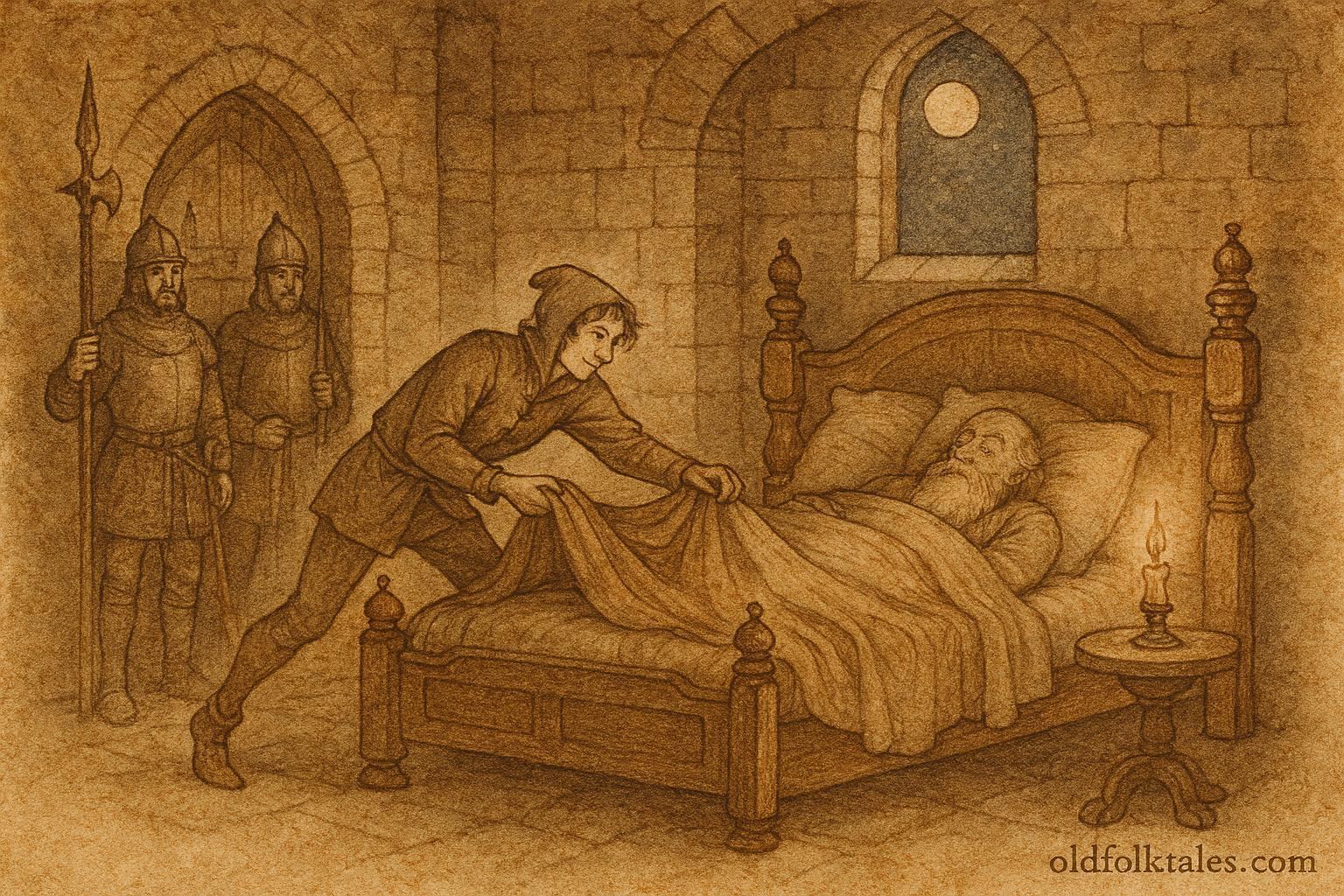
“You must steal the bedcovers from beneath me while I sleep tonight,” the king said.
The entire court gasped.
The king’s chamber was guarded more heavily than any place in the castle.
Yet the Master Thief accepted the challenge.
That night he disguised himself as an old beggar and waited outside the castle walls until darkness covered the land.
Using ropes and quiet patience, he climbed to the window of the king’s chamber.
Inside, the king slept soundly.
Slowly, carefully, the thief began loosening the blankets at the edge of the bed. Little by little he pulled them away, inch by inch, so gently that the king never stirred.
At last, he held the entire bundle of bedcovers in his arms.
He slipped quietly out the window and vanished into the night.
When the king awoke the next morning, the blankets were gone.
And standing proudly in the hall below was the young thief, carrying them.
The king burst into laughter.
“No guard in my kingdom could catch you,” he declared.
“You have proven that wit is stronger than force.”
Instead of punishment, the king rewarded the Master Thief for his extraordinary cleverness.
From that day forward, the young man’s name became legendary across Norway, and people continued to tell the story of the thief who could outthink even a king.
Discover the moral heart and wild spirit of the north through timeless Nordic storytelling
Moral Lesson
“The Master Thief” teaches that intelligence, creativity, and careful observation can overcome even the strongest authority. Rather than brute force, clever thinking allows problems to be solved in surprising ways. The story celebrates wit and reminds listeners that quick minds can triumph where strength alone cannot.
Knowledge Check
1. Who is the Master Thief in Norwegian folklore?
The Master Thief is a clever young man who becomes famous for outwitting guards and completing impossible challenges.
2. What challenges does the king give the Master Thief?
The king challenges him to steal a roast from the kitchen, the royal horse from the stables, and the king’s bedcovers while he sleeps.
3. What theme is central to the folktale “The Master Thief”?
The story emphasizes intelligence, cleverness, and the power of quick thinking over authority.
4. Why does the king challenge the thief?
The king wants to test whether the thief’s reputation for cleverness is truly deserved.
5. What lesson does the king learn in the story?
The king learns that wit and ingenuity can succeed where strength and strict guards fail.
6. Where does “The Master Thief” folktale originate?
The story comes from Norway and is part of traditional Norwegian folklore.
Source: Collected in Norske Folkeeventyr by Peter Christen Asbjørnsen and Jørgen Moe, first published in 1841.
Cultural Origin: Norway.